
How To: Revive Sourdough Starter

Don’t throw away that neglected starter sitting in your fridge, revive your sourdough starter and bring it back to bubbly, active life with this simple feeding schedule and troubleshooting guide. Even starters forgotten for months can be brought back from the brink.


Master Your Sourdough Starter In 5 Days!
From Confused To Confident.
Find success with 5 simple, actionable secrets delivered to you. No more guessing games – just clear, proven steps to a thriving starter.
Jump to:
Watch Me Revive My Starter!

Raise your hand if this sounds familiar…
You’re cleaning the fridge mid-September and you come across the sourdough starter you haven’t seen since May when the sunshine was calling and the shorts came out.
“Oh my god. FRED!”
Don’t worry, you can revive a sourdough starter that’s been long neglected in the fridge! Even if you neglected it as long as I did…
May 12, 2021 and September 15, 2021:
- 126 days
- … or 18 weeks
- … or 4 months & 3 days
So don’t throw out that old sourdough starter just yet!
This guide to reviving sourdough starter is dedicated to shorts season.

Expert Tips
- Almost any sourdough starter can be revived! Don’t panic, your fermenty baby is gonna be ok, and you’ll be back to sourdough bread baking in no time!
- Take a critical look at your neglected starter, the section below details what to look for. If you think your starter has gone bad, scrap it and start fresh.
- Always try to feed your starter with the flour it was raised on. For example, if you’ve always fed it bread flour, keep feeding it bread flour. The same goes for whole wheat, whole grain, all purpose, rye flour, or gluten-free.

Moldy Sourdough Starter
While almost any starter can be revived, I don’t play with mold. Fermenting foods takes a little bit of intuition and a little bit of ruthlessness. If something looks, smells, feels, or just could be bad – it finds the garbage quickly!
Look:
If your old starter has any kind of mold, toss that bad boy, start fresh with my 24-hour starter recipe, and you’ll be just fine! After the mold, look at the hooch – if it has grey or black-ish looking hooch, we’re in business! If the starter or hooch is pink-tinged, it’s gotta go!
Smell:
If the starter smells tangy, like vinegar, alcohol or even nail polish remover, it’s safe to use. If it has a musty or moldy smell, toss and start over!
Feel:
After a long fridge nap, your starter should be thin and liquid. If it’s thick or chunky, toss it and start over!
Read More: How To Tell If Your Sourdough Starter Is Bad
Reviving Sourdough Starter
- Remove the unfed sourdough starter from the fridge and allow it to rest at room temperature for 3-4 hours.
- Look closely at the starter, discard immediately if your starter has mold, a pink tinge, or smells musty. These are signs that bacteria have overtaken the yeasts. If the starter passes the test, stir in the hooch, or pour it off. I prefer to stir it back in to keep my hydration levels correct, but it can be poured off too.
- In a clean jar or container, mix 50g of the unfed starter with 50g warm water, stir until combined, then add in 50g flour.
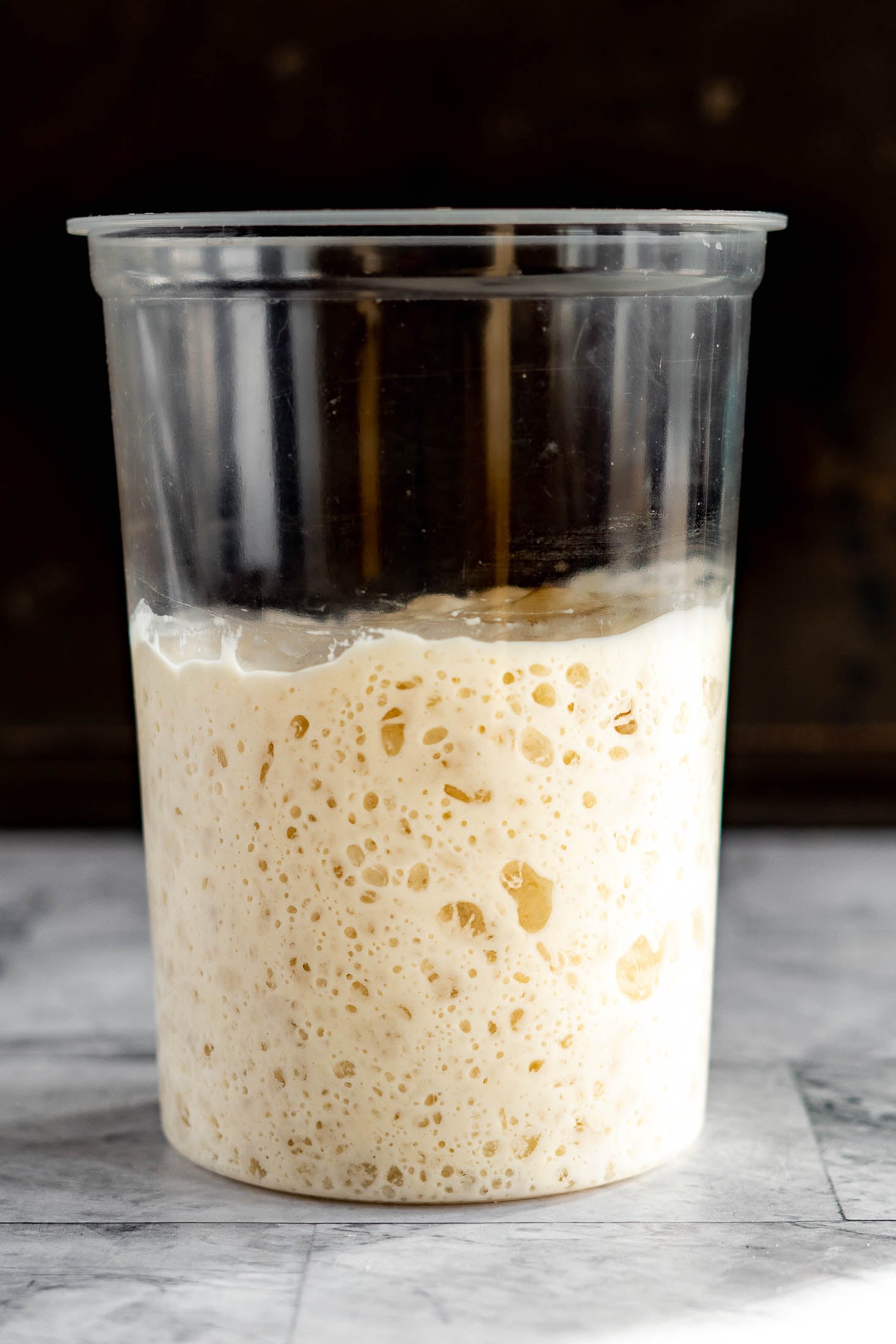
- Set aside the fed starter for 12 hours, then feed it again using a fresh clean jar, combine 50g starter, 50g water and 50g flour. Mark the side of your jar with the height of the starter. Watch the starter for signs of activity. It may be a little bit sluggish, but you should start to see a few bubbles here and there.
- If the starter is close to doubling within 12 hours, wait 24 hours before feeding again. If the starter is not close to doubling by 12 hours later, feed it again – and repeat until the starter doubles within 12 hours, then reduce to a 24 hour feeding period.
- Once the starter is revived and doubling regularly, it should be maintained on the counter and fed every 24 hours for 4-5 days. This will help get your starter healthy again before it’s placed back in the fridge.
- Ensure to feed your starter weekly or bi-weekly once it’s in the fridge to keep it healthy and active and ready for sourdough baking!


It’s Not Just You!
Other people have accidentally neglected their sourdough starter too! Here is what they had to say after saving their fermenty friends:
I was going to toss my sourdough starter thinking it I had to toss it. Thanks to this website I am reviving. This is the best site I have ever seen. Love the pictures and step by step instructions. This is now my source for all things sour dough.
– Dee
My starter would not rise and I needed an understanding and solutions. This article helped a lot!
– J
Sourdough Starter Feeding + Maintenance
There’s a lot to sourdough, but there’s also not a lot to sourdough! One of the things you’ll have to decide is how often you’ll be baking. For me, in the fall and winter months, I bake much much more frequently. So I actually use different sourdough feeding and maintenance methods depending on the time of year.
Daily to Bi-weekly Baker
- you’ll want to keep your starter at room temperature and feed it daily. This will keep it warm and active whenever you’re ready for it!
- feed it around every 24 hours. You can play with the feeding schedule a bit, once you get to know your starter and how hungry it is. The starter should be fed after the culture doubles in size and deflates.
Weekly or Less Frequent
- keep your sourdough in the fridge! This slows down the fermentation time considerably and allows you to feed your sourdough only once a week.
- simply remove it from the fridge, then stir and feed, and rest for 12-24 hours at room temperature before starting with your recipe. Once the fed starter doubles, it is ready to use!

Put That Sourdough Starter To Work!



Long-Term Sourdough Storage
If I had been smart, I would have used the remainder of my sourdough from the fridge and revived a backup I saved much earlier last year. But I’m always up for a challenge, so I decided to revive my starter. If that’s not for you, check read my post about long-term sourdough starter storage.
Freeze it:
- Freezing a sourdough starter is a quick and easy way to take a break from your starter.
- It’s quick and easy to do.
- Requires no feeding until thawed.
To revive the frozen starter simply allow it to thaw at room temperature before feeding it with equal parts of starter, flour, and water.


Dry it:
- Dehydrating sourdough starter is bit more involved than freezing, but kinder to the yeast in the starter.
- Requires no special tools.
- May take a bit longer to revive than a frozen starter.
To revive the dried sourdough starter, mix equal parts, by weight, of the dried starter and warm water. Allow it to completely re-hydrate the starter and then feed it with equal parts of starter, flour, and water.


Master Your Sourdough Starter In 5 Days!
From Confused To Confident.
Find success with 5 simple, actionable secrets delivered to you. No more guessing games - just clear, proven steps to a thriving starter.
📖 Printable Recipe
How To: Revive Sourdough Starter
Ingredients
- 50 g unfed sourdough starter
- 500 g flour, divided
- 500 g water, divided
Instructions
- Remove the unfed sourdough starter from the fridge and allow it to rest at room temperature for 3-4 hours.
- Look closely at the starter, discard immediately if your starter has mold, a pink tinge, or smells musty. These are signs that bacteria have overtaken the yeasts.
- If the starter passes the test, stir in the hooch, or pour it off. I prefer to stir it back in to keep my hydration levels correct, but it can be poured off too.
- In a clean jar or container, mix 50g of the unfed starter with 50g warm water, stir until combined, then add in 50g flour.
- Set aside the fed starter for 12 hours, then feed it again using a fresh clean jar, combine 50g starter, 50g water and 50g flour. Mark the side of your jar with the height of the starter.
- Watch the starter for signs of activity. It may be a little bit sluggish, but you should start to see a few bubbles here and there.
- If the starter is close to doubling within 12 hours, wait 24 hours before feeding again. If the starter is not close to doubling within 12 hours, feed it again 12 hours after the initial feed- and repeat until the starter doubles within 12 hours, then reduce to a 24 hour feeding period. When the starter has reached the 24 hour feeding cycle, it is ready to bake with.
- Once the starter is revived and doubling regularly, it should be maintained on the counter and fed every 24 hours for 4-5 days. This will help get your starter healthy again before it's placed back in the fridge.
- Ensure to feed your starter weekly or bi-weekly once it's in the fridge to keep it healthy and active.
Video




I have a starter that may be dead. It has been a couple of months since I used it. It would not raise, so I put it into my bread maker, added yeast and made dough and into a couple of loaves of bread that were really good. but, now I think it is dead. I may try to revive it, according to your directions..
Do it! Nothing ventured, nothing gained. Mine sat neglected in the fridge for over 4 months and it came back stronger than ever, so I say go for it!
@Ally, It was slow going for awhile (maybe because I make 100% whole wheat starter) but I’m glad I was patient, because this morning I was thrilled to see the starter finally doubled!
Now, a few questions, just to be clear:
1. For the 24 hour periods at room temperature, I should still use only 50g of the now doubled starter into a clean jar each time and toss the rest (even though it doubled)?
2. However, for the feed done right before putting into the fridge, I figure I should then take out 100g and mix it with 100g flour + 100g water because my bread recipe routinely calls for 150g starter per loaf. That way when I next make a loaf, I’ll have 300g in the fridge from of which I take out 150g for the loaf, leaving 150g to be fed a new.
3. BUT going forward, once the starter is revived and in the fridge, should I always feed it in equal amounts of starter/flour/water (1:1:1)? If so, that suggests I should always repeat step #2 above – feeding only 100g at a time and tossing out 50g, otherwise I’ll be creating a growing amount of starter going forward. Does that make sense?
4. I bake 100% whole wheat bread with Mark Bittman’s dutch oven method. His feeding regimen has you feed the remaining starter with the same *total* amount of flour and water as the starter you removed — so for example: if I take out 150g starter for the loaf, I feed the remaining starter with 75g of flour and 75g of water. That way, you don’t keep growing the amount of starter on hand and don’t have to toss any out. So that differs from step #3 of feeding equal amounts of starter/water/flour each time and tossing or using the excess.
BUT the fact is – after a year of doing Bittman’s method, my starter slowly fizzled out which is why I am now reviving it. I’m naturally wondering if the reason for the loss of activity was the lack of 1:1:1 feeding, as per step #3 above. What do you think?
Hi Jerry!
A quick thought on this results in these answers:
1. You can keep as much starter as you like – I like to use 50g because it tends to be the perfect size for me to store in a pint jar, have 60g for my regular sourdough recipe and enough leftover to feed 50g. You don’t need to toss the discard, you can store it, and bake with it!
2. I 100% agree with your thoughts on this. This is the perfect way to do it, to ensure that you always have enough on hand for your go-to sourdough recipe!
3. You’re exactly right here. I always feed my starter 1:1:1, and circles back to the reason that I only feed 50g. LOL Starters grow exponentially, so it’s important to keep a manageable amount on hand – hence the discard. That said, I find discard to be a misnomer because it can be saved and used in tons of recipes. It’s discarded in the sense of feeding the starter, but not necessarily tossed in the trash.
4. It’s very possible that the feeding method could have caused your issues. I can see what he’s trying to accomplish – a no-discard starter, but I think in order for the starter to stay healthy and viable, it needs to be refreshed by discarding.
I was going to toss my sour dough starter thinking it I had to toss it. Thanks to this web site I am reviving. This is the best site I have ever seen. Love the pictures and step by step instructions. This is now mysource for all things sour dough.
I got through step 4 and then my starter doubled in 8 hours and looks beautiful! Is there a reason I cannot just go ahead and start using it now? I’m confused about the next step: wait 24 hours and feed again. Is that necessary? Thanks for helping!
Hi Abi, I guess that depends on how neglected your starter was! If it doubled after a single feeding, it was probably in reasonably good shape. I find after a prolonged time without feeding my starters can double in the jar easily, but don’t always have the leavening power to raise bread. I have done exactly what you’ve done multiple times and was mad at myself each time because the loaf was not impressive – dense, poorly fermented, flat, and bland tasting. My opinion would be to give it a second feed before baking, based on my experience!
@Ally, ok thank you for explaining. But now that my starter is doubled and bubbly after two feedings, should I wait for it to fall again before feeding? You said wait 24 hours which is why I’m asking, still trying to understand. I’m used to the imperative need to use the starter asap once it’s doubled, making sure not to wait too long before it deflates. But you’re saying to let this one go for 24 and then continue to feed 50/50g? My starter was neglected for most of the year in the fridge!! So it’s confusing that it became seemingly active so quickly.
No problem! The 24 hours is just a rough guideline for feeding, you can go 36 or 20, whatever fits in your schedule. I never feed my starter until it has collapsed – if it’s still inflated it means that the yeast is still finding food – allow them to eat it all before you feed. It is important to use the starter when it’s at least doubled and active after a feed to bake with, but that is not necessary for feeding!
UPDATE! I did as I said and fed it with bread flour and it doubled in 7 hours! Back in business on a strict bread flour diet. 🙂
Ah! So glad to hear it came back!
Help! My daughter brought sourdough starter to me. It grew up on AP flour, then we fed it with bread flour and it was fine. Then we fed it with a different kind of AP flour and it’s not growing. THEN I read that you say not to change the type of flour. ;(. So. Now it is getting watery on top (is that hooch?). I am going to start consistently feeding it with bread flour. Will that work? Thanks!
howdy, i started reviving on sunday, still working on feeding every 12 hours, and it’s now thursday; smells/looks great so far, but i’ve not yet gotten any significant volume increase and it’s starting to make me nervous lol. also, should i be discarding before feeding? please and thanks in advance!
Hey Hannah, it should be pretty close – I’d try to feed it and wait 24 hours to see if you get a decent rise – it might just be slow! Yes you should be discarding and only feeding equal portions of starter, water and flour.
Am trying to revive mine today to get ready for winter baking. Mine has been in the fridge since April, I fed. It had greyish hooch and smell c like vinegar.
I used mostly rye flour, hope that is ok. Waiting to see what happened after 22 hours.
Thanks for your post. It’s very helpful!
It should be just fine! Good luck!
Ps. I’m happy we’re back in winter baking season LOL
Hi there! I’m so thankful you have this post! I’m reviving mine and I poured out the hooch and scraped as much off as I could. I fed it and 24 hours later, I now know it’s supposed to be 12, it was hoochy on top again. I fed it less than 12 hours today and it’s hoochy. Am I doing it right? Im doing equal parts of of starter, water and whole wheat flour. Do I need more water? This is what I’ve always done though but im wondering if I need more because I poured off the hooch.
The small amount of hooch you poured off won’t overly affect the hydration of your sourdough starter, eventually, it will get back to 100%. If the starter has hooch on top it’s cause it’s hungry, just keep up what you’re doing and it will bounce back!
Thank you for taking the time to share your expertise with us. It was very helpful.
when we let it sit, do we put a lid on it?
Thanks!
Yes you can put a lid on it, ensure it’s not airtight though!
Is there any discarding done at all during this reviving process? Thanks for your answer in advance!
Yes, you’ll be discarding all but the 50g of starter you use every day. You can save the discard in a container in the fridge and bake discard recipes, like in sourdough discard brownies!
Once I have my starter revived, how do I scale it up for bigger bakes? Do I use the same ratios of starter, water, flour in larger equal increments?
When you’re ready to scale your starter, add equal amounts of starter, flour and water! You could do 100g starter, 100g water and 100g flour – just be aware that it multiplies super fast so you can end up with way more starter than you need!
Your recipe calls for 500g of flour and water. That number seems way too high.
Hey Kelsie, the ingredients calls our 500g to ensure you have enough flour on hand to reactivate the starter – as some can be sluggish after a long famine. The directions within the recipe explain that you’ll only be feeding it 50g flour and 50g water at each feeding. Having 500g on hand means that you’ll have enough for 5 twice a day feeds or 10 daily feeds, but more likely a combination of both.
Hope that helps!
@Ally, definitely only saw 500g of flour and water under Ingredients, so that’s what I did (the whole time thinking, this just doesn’t seem right). However, my dormant starter loved it and doubled in 24 hrs! When I returned to the instructions to see what’s next, I saw where there were two sets of measurements. Once I read your explanation it made sense. Thanks for saving the sourdough day!
Oh my gosh! I am so sorry, I’ve edited the ingredients section to specify “divided” to be more clear!!
Super happy to hear that your starter loved the smorgasbord hahaha!
Hello!
What do you do with the original starter that you took the 50g from? Toss it?
Yup just toss it out!
@Audra, there are also great tossout recipes for the unused starter. I usually make overnight pancakes with mine
Thank you for this informative and detailed explanation. I am on my way to reviving my starter at this moment!
Good luck! Let me know how it goes!