
Canning Pickled Jalapeños

Preserve your fresh jalapeño harvest with this easy water bath canning recipe that creates tangy, crispy pickled jalapeños perfect for tacos, sandwiches, and nachos. This beginner-friendly method requires just a few ingredients and basic canning equipment.

Craving The Recipe Details?

What it is: Tangy, crisp pickled jalapeños preserved in a simple vinegar brine with garlic and a touch of sugar.
Why you’ll love it: This easy water bath canning recipe turns a fresh jalapeño harvest into shelf-stable pickled peppers with plenty of bright, vinegary heat.
How to make it: Slice fresh jalapeños into rings, toss them into boiling brine, then pack into pint jars and process in a boiling water bath.
You know you’re in for something when your mom calls giggling. “I’ve got some garden goodness for you!”
Later that day, she dropped off 5 pounds of fresh jalapeños. FIVE POUNDS.
So I did my usual, and I got busy; dehydrating jalapeños, freezing jalapeños, fermenting jalapeños, and I STILL had a bowl full of hot peppers left.
Kevy walked by while I had the kitchen straight up destroyed and saw the pile of jalapeños that still needed to be preserved and the defeated look on my face. Thankfully, he’s the brains of this operation and he reminded me that it’s been a few years since I canned pickled jalapeño peppers.
Five pounds of jalapeños is exactly the kind of harvest that makes a small refrigerator pickle recipe feel useless – I needed a way to preserve a serious quantity of peppers for the pantry, so out came the canner.
This pickled jalapeños recipe is dedicated to the brains.
Jump to:
Refrigerator Vs. Canned: What’s the Difference?
You’ll find two very different types of “pickled jalapeños” online, and what type you choose matters!
| Quick Pickles / Refrigerator Pickles | Water Bath Pickles | |
|---|---|---|
| Storage | Fridge only | Pantry, until opened – then fridge |
| Shelf Life | 2 -4 weeks | Up to 12 months |
| Equipment Required | None | Water bath canner |
| Time | ~30 minutes | ~1 hour |
| Best For | Small batches, eating soon | Preserving a big harvest, eating in the future |
Neither method is “better”, it just depends on your goals. If you’re working through a big harvest (thanks, Mom!), or like to have them in your canning pantry, a water bath recipe is better suited to that job. If you’ve got a handful of jalapeños and you plan to eat them within a couple weeks, you really want a quick pickle recipe.
These are canned pickled jalapeños, not refrigerator pickles.
Key Ingredients
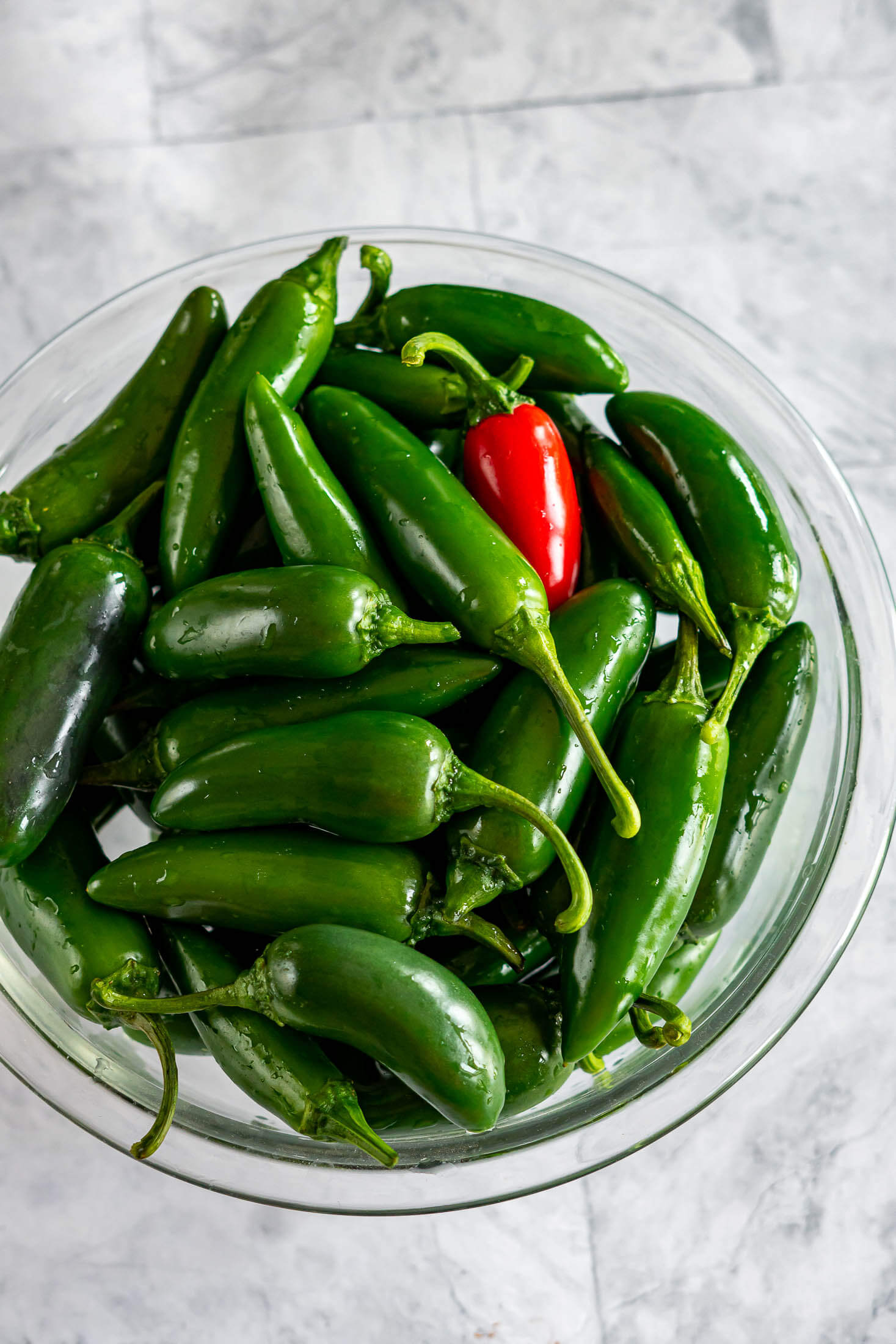
Jalapeños: Choose fresh, firm, ripe jalapeños without blemishes, holes, or mold. Any jalapeños with wrinkled or dark spots should be either discarded or have those bits cut out. This recipe also works well with banana peppers and other hot peppers!
Vinegar: Use white vinegar with 5% acidity. The vinegar acidifies the jalapeños and is an important part of the preservation process. Don’t adjust the amount of vinegar or increase the water.
Sugar: Reduces some of the sourness of the vinegar and saltiness of the pickling salt.
Pickling salt: Salt is added for flavor in this recipe as the vinegar provides the acidification needed for preservation. If you don’t have canning salt, you can replace it with coarse kosher salt.
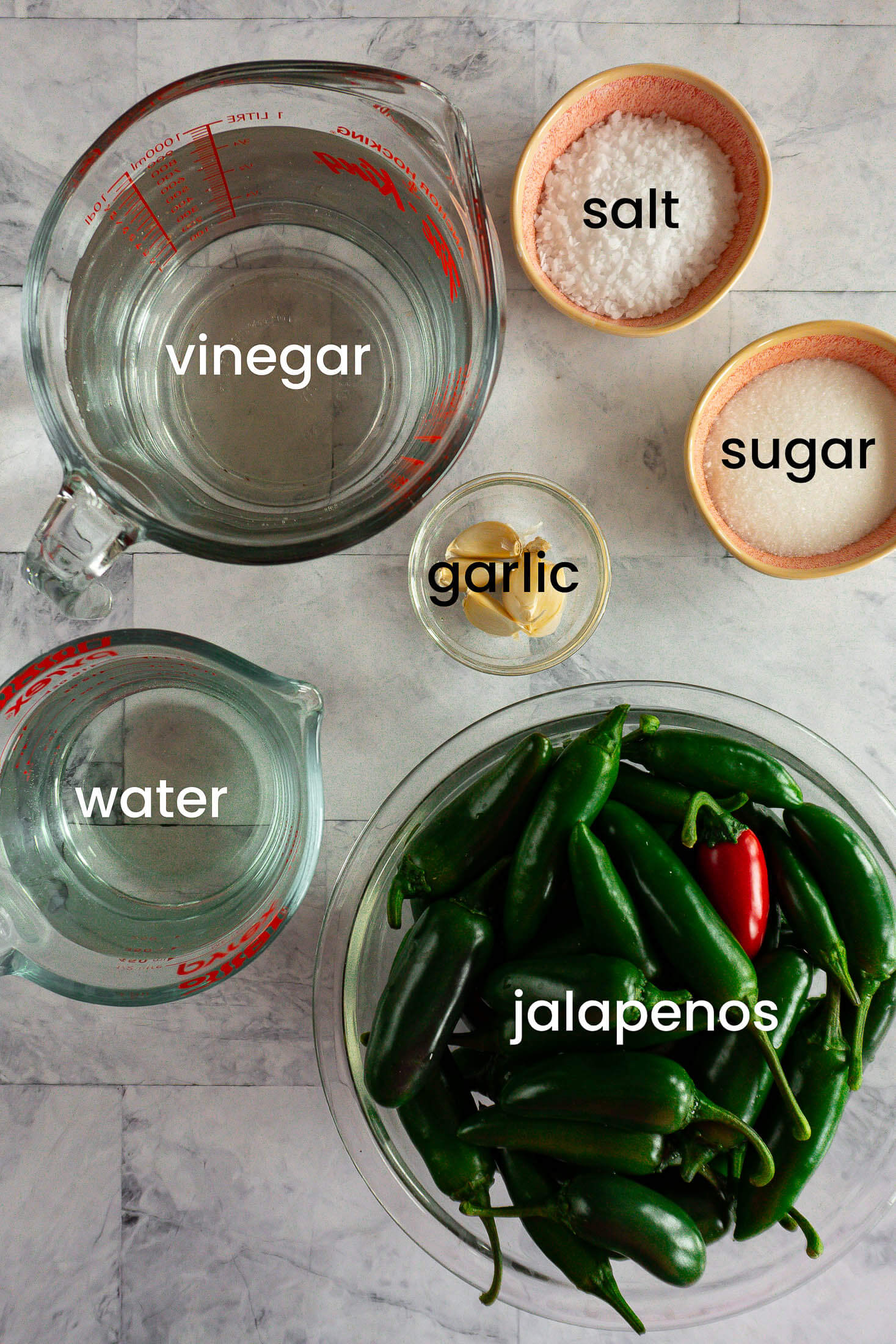
How To Can Pickled Jalapeños
Prepare Canning Jars:
- Step 1: This recipe makes 3 pint jars and does not require sterilization due to the processing time. Prepare your jars, flats, and rings by washing in hot soapy water and rinsing well before setting aside on a clean kitchen towel until you're ready to use them.
- Step 2: Fill a water bath canner, and set to boil over medium high heat.
Make The Brine:
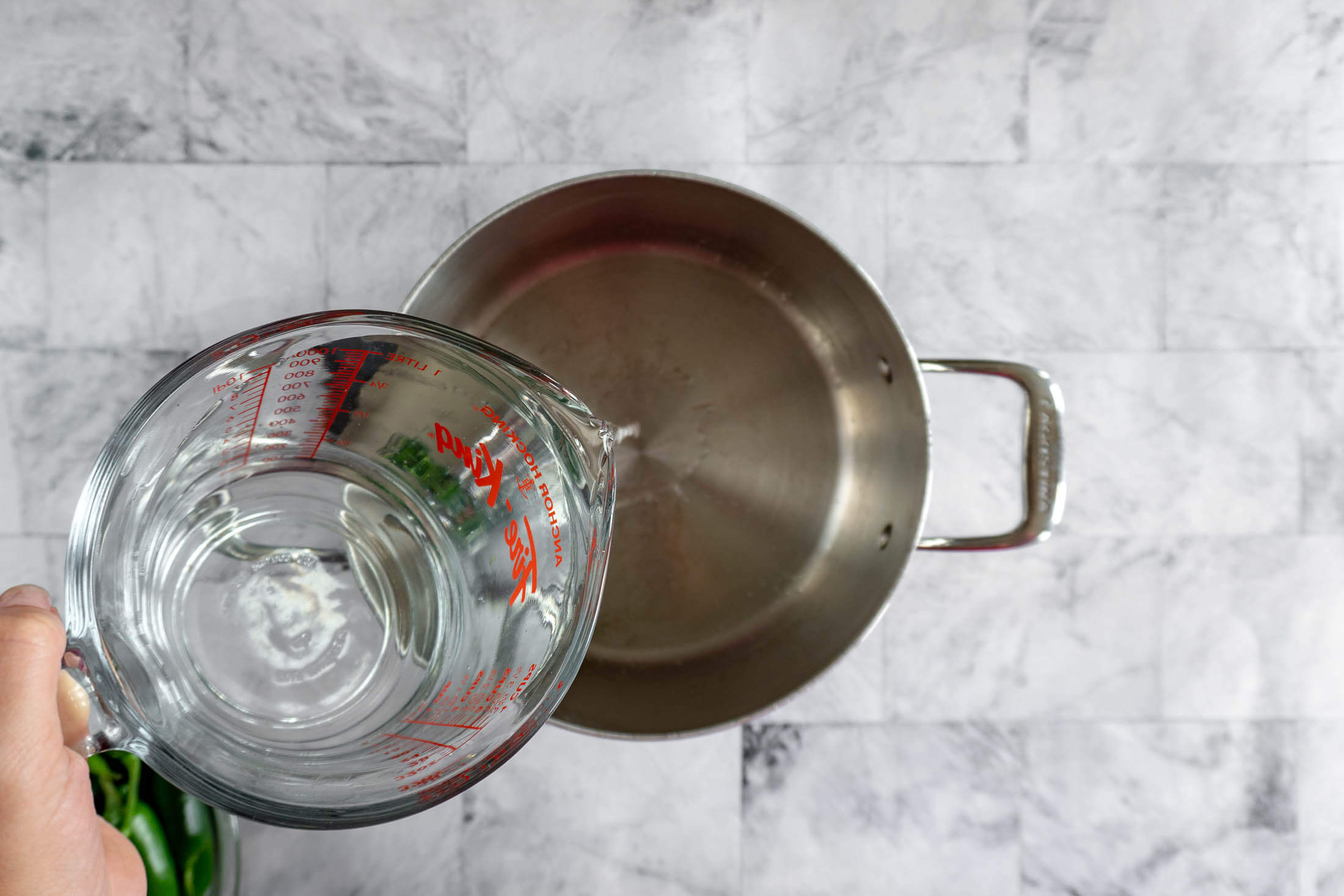
- Step 3: Add 6 cups of vinegar, 2 cups of water, 1/4 cup pickling salt, and 1/4 cup granulated sugar to a large saucepan.
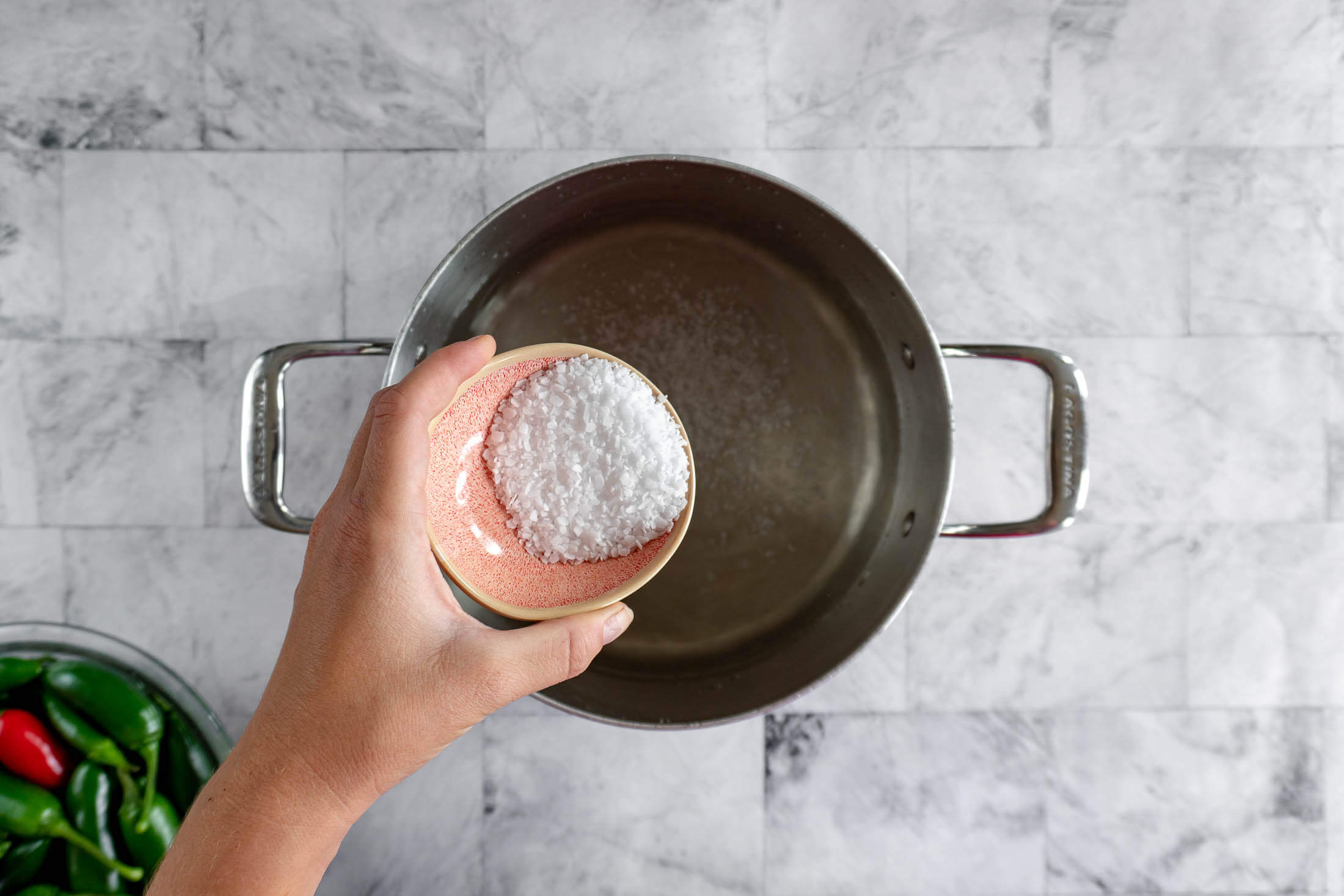
- Step 4: Bring the brine to a boil.
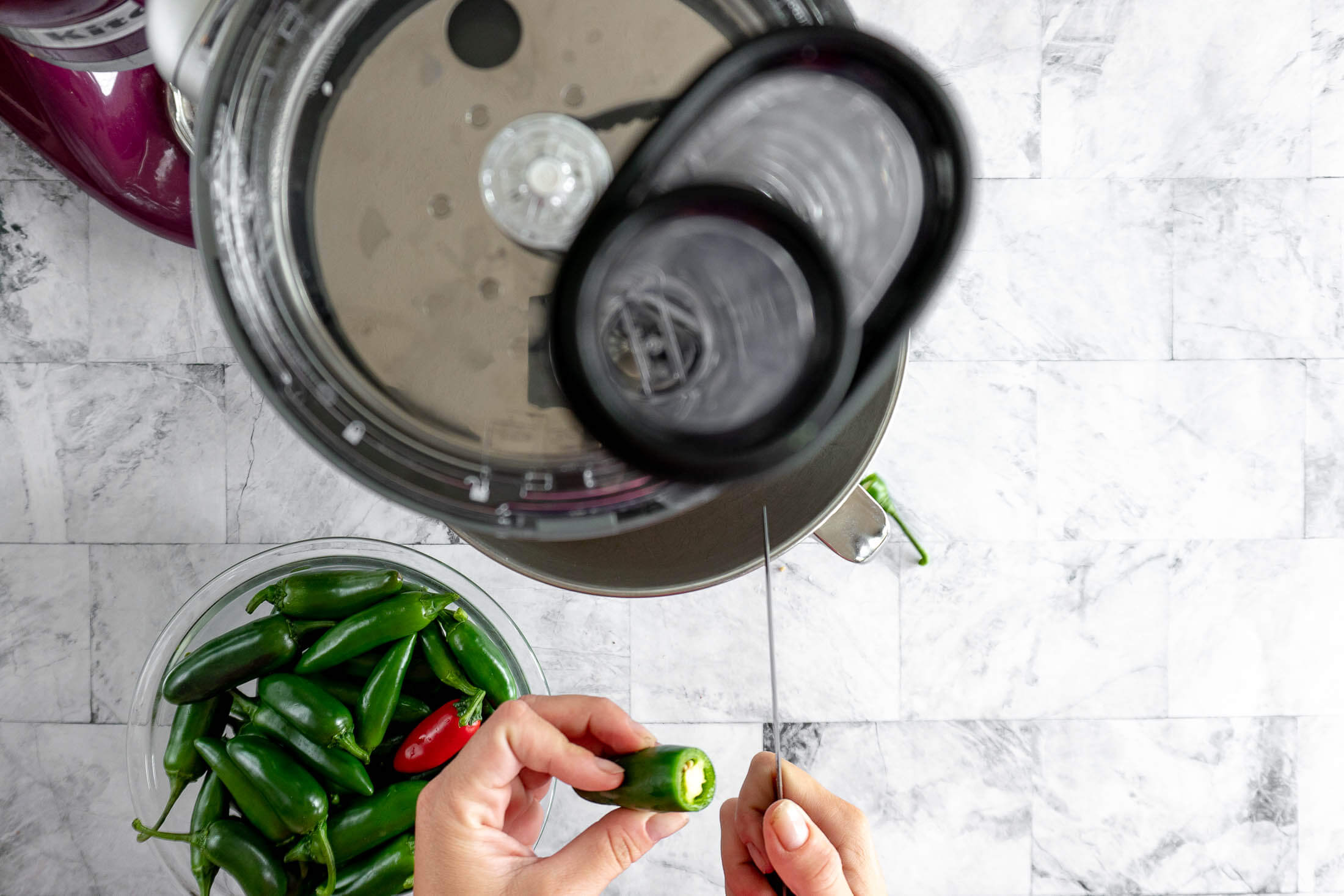
- Step 5: Meanwhile, wash 2 1/2 - 3 lbs jalapeño peppers well, and slice into even sized rings.
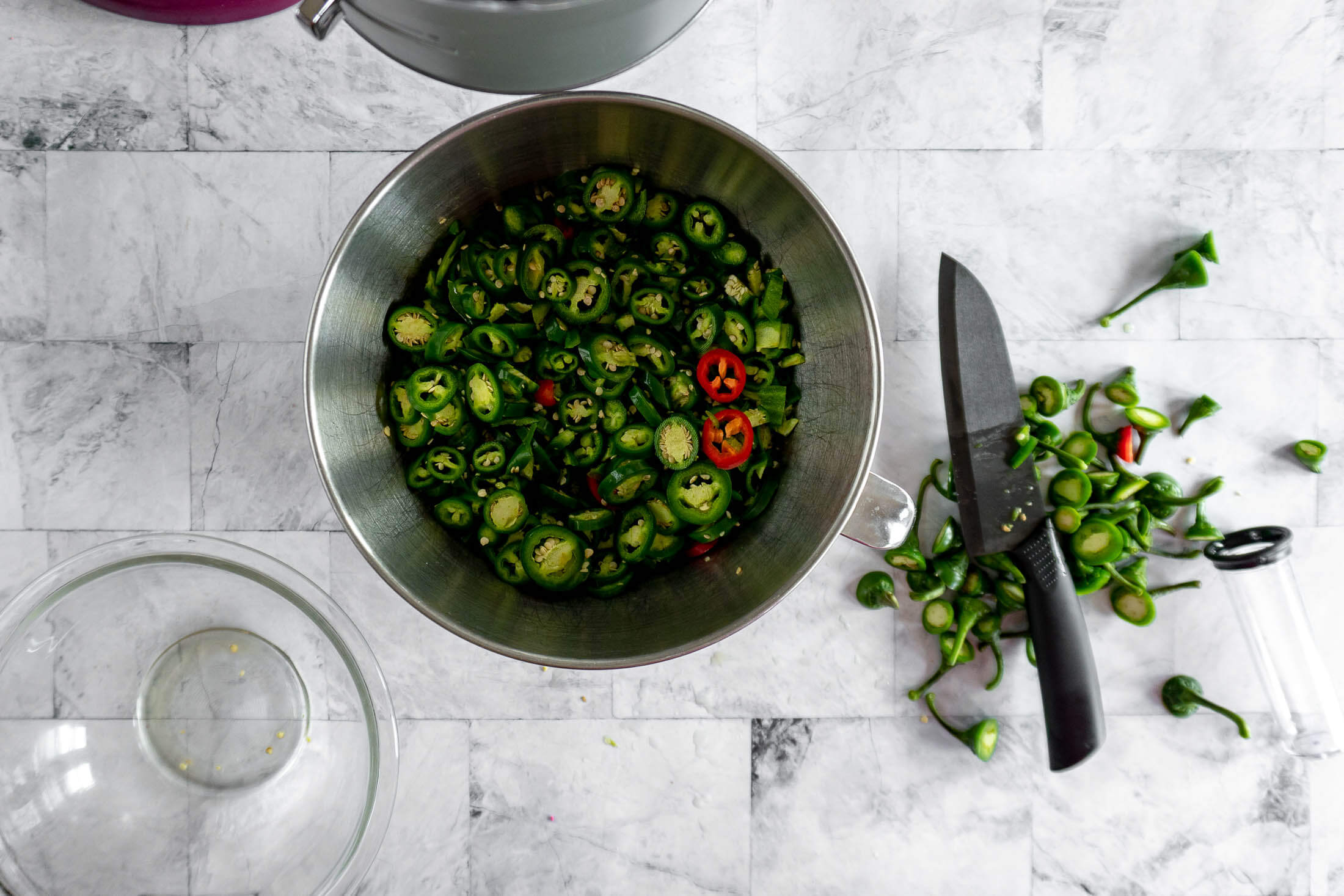
- TIP: I use my KitchenAid Exact Slice attachment for this job to make it quick and painless.
Fill And Process Jars:
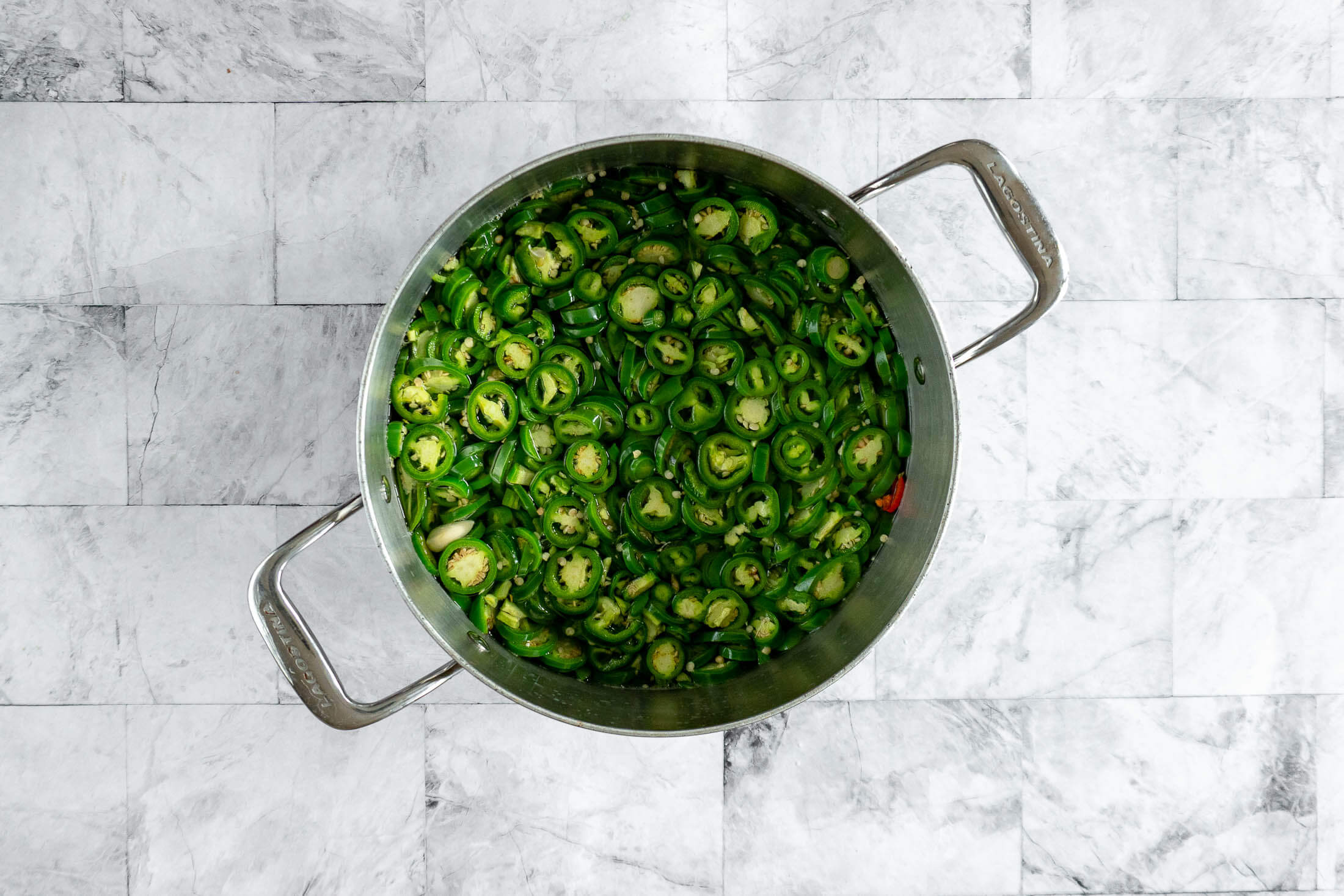
- Step 6: Once the pickling liquid comes to a boil, remove from heat and add the jalapeño slices and crushed garlic cloves.
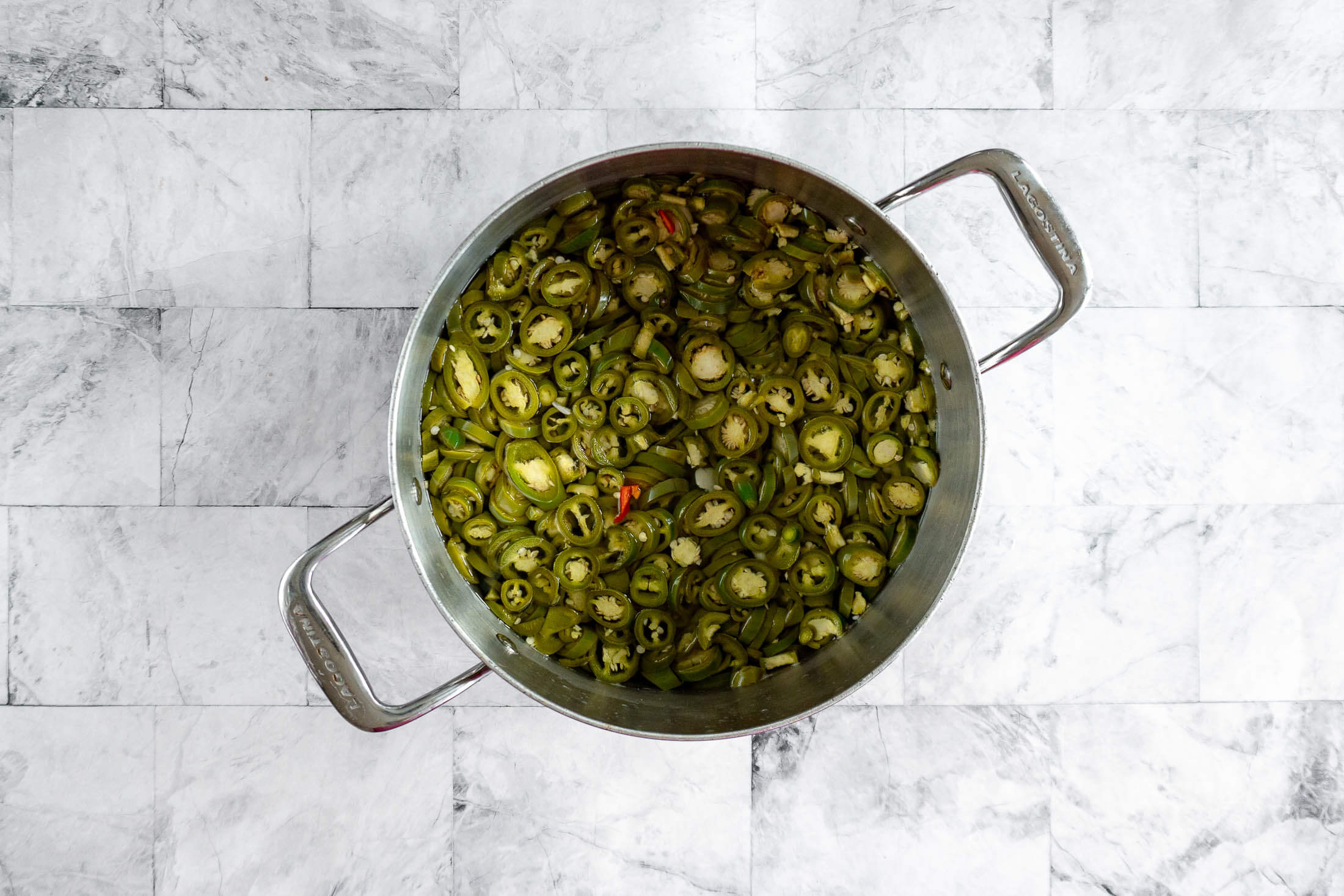
- Step 7: Soak the jalapeños for 30-60 seconds – they will change to a deeper, duller green, this is normal.
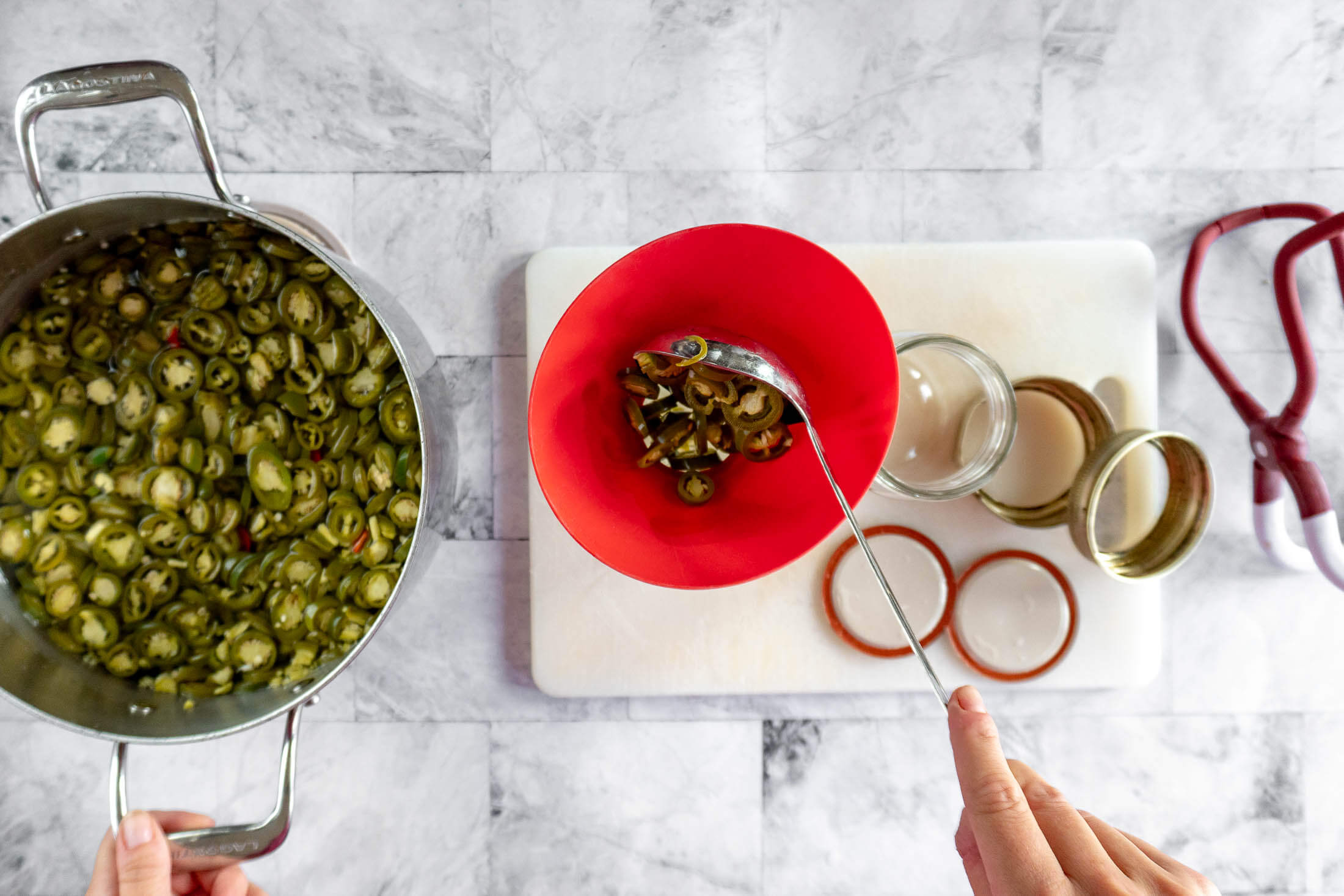
- Step 8: Then place a canning funnel on top of the jars and ladle the jalapeño rings and hot brine into the jars. Top off each clean jar with brine, leaving 1/2 inch headspace. If desired, run a canning spatula or clean chopstick along the edges of the jar to release the air bubbles.
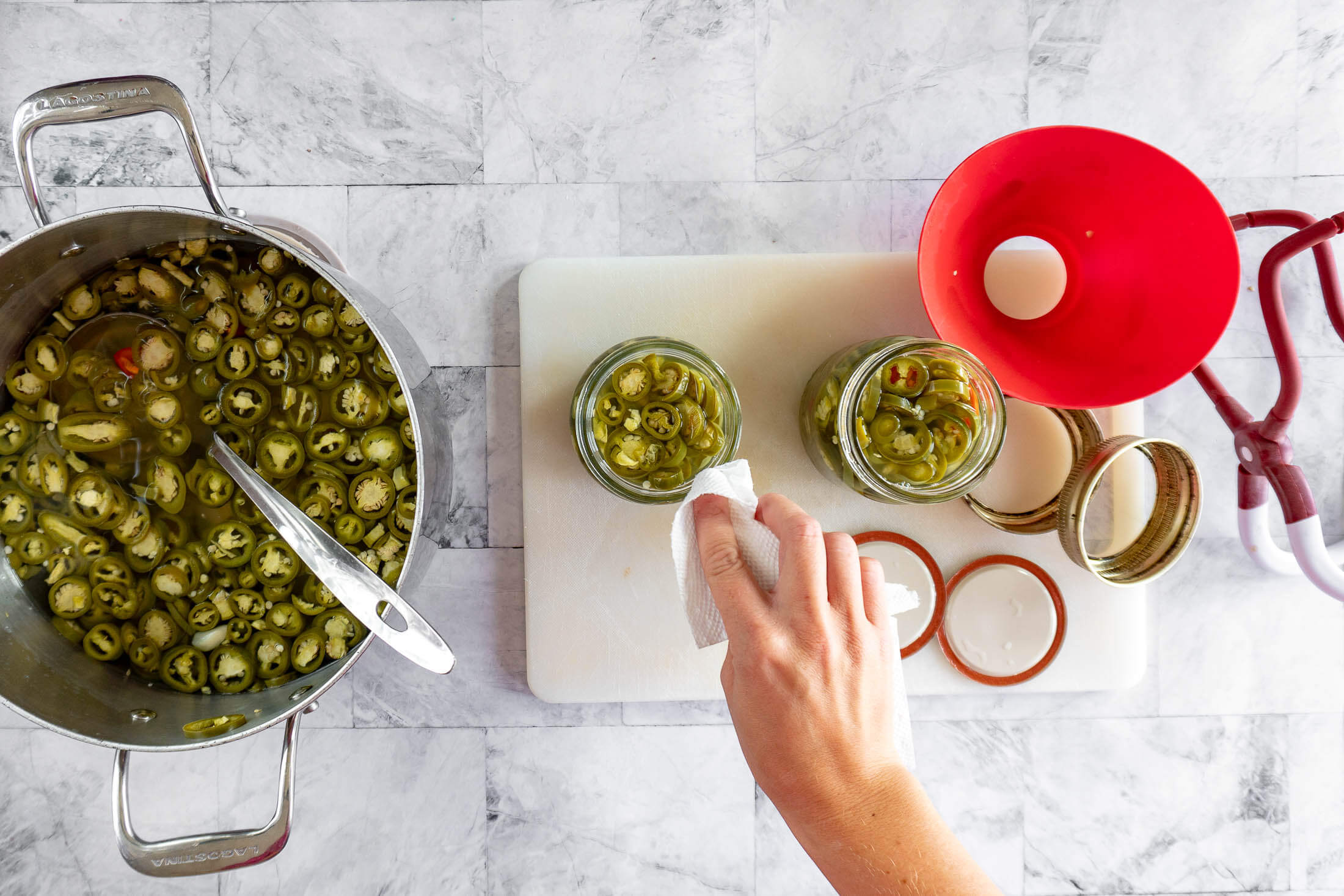
- Step 9: Wipe the lip of each jar before placing the lid and tightening the rings finger-tight. Transfer filled jars to the prepared boiling water canner using a jar lifter, ensure the jars are covered by 1-2 inches of water, cover the canner and return to a full boil.
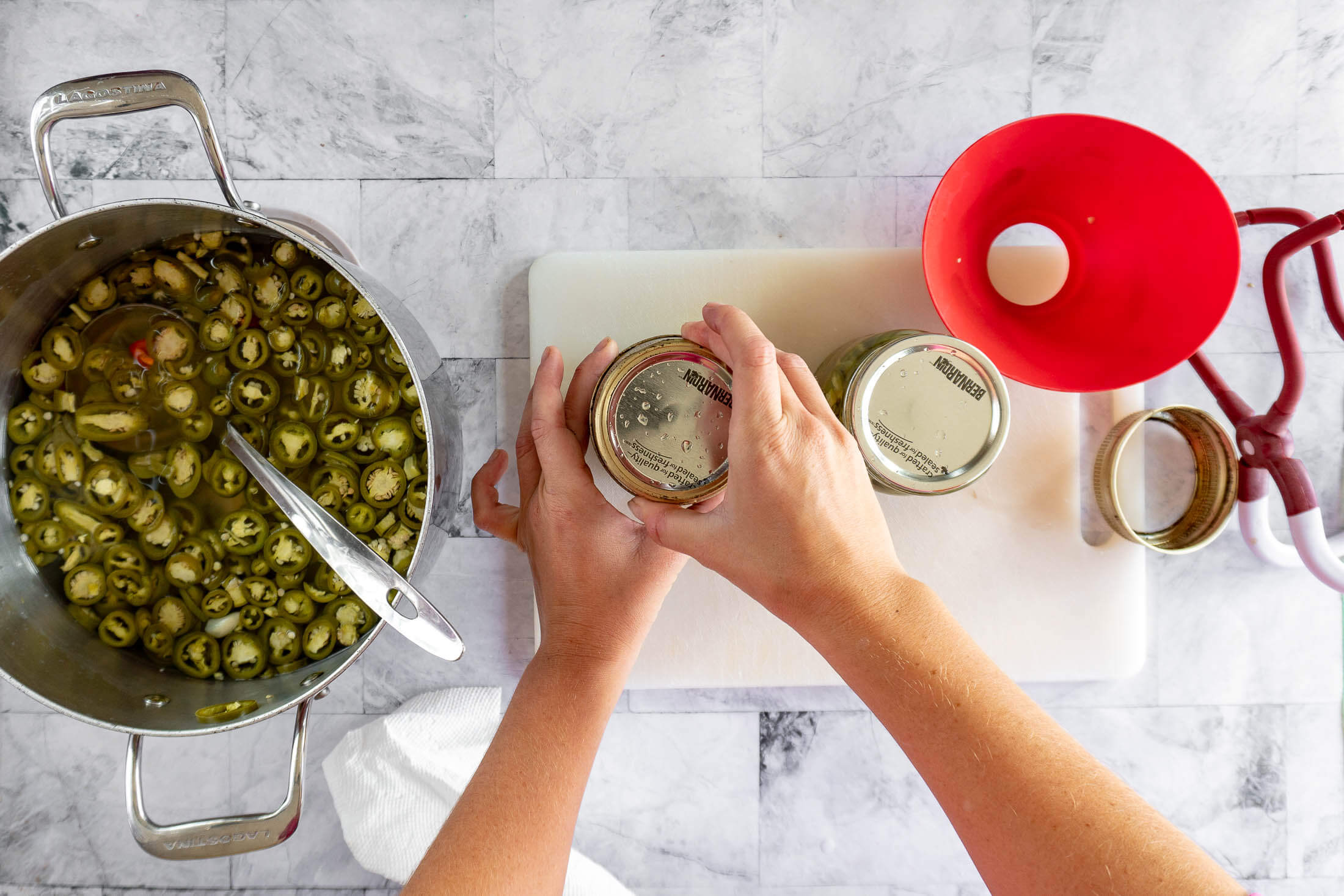
- Step 10: Once the water bath returns to a boil, begin to process for 10 minutes (at 0- 1,000 feet above sea level, see section below altitude adjustments).
- Step 11: When processing is complete, turn off the heat, remove the lid from the water bath canner, and rest for 5 minutes before removing the hot jars and transferring them to a heat-proof surface to cool untouched for 24 hours, before wiping down, labeling with the contents and year and transferring to your storage pantry.
Canning Safety
Sterilizing Jars:
National Center For Home Food Preservation has clear guidelines about sterilizing jars. The TL;DR is that if you’re processing for at least 10 minutes, pre-sterilization is not required.
Since this recipe processes for at least 10 minutes, the jars don’t need pre-sterilization.
Processing Times:
Processing time depends on your elevation. As elevation increases, water boils at a lower temperature, so longer processing times are required.
Canning Science 101: Pasteurization depends on both time and temperature. When the processing temperature is lower, as it is in higher elevations, a longer exposure time to heat is needed to achieve microbial reduction.
Water Bath Canning Time By Elevation :
| Jar Size | 0-1,000 feet | 1,001 - 3,000 feet | 3,001 - 6,000 feet | 6,001 – 8,000 feet |
|---|---|---|---|---|
| Pint | 10 minutes | 15 minutes | 20 minutes | 25 minutes |
Expert Tips
- Glove up. Slicing 2-3 pounds of jalapeños bare handed is how you end up sleeping with your hand in a bowl of milk (ask me how I know). Wear rubber or latex gloves, and if you forget and your hands start burning, rinse your hands in cooking oil before washing with dish soap to help breakdown the capsaicin.
- Adjust your time. Don’t forget to adjust your processing time based on your elevation. The table above has you covered. Higher up means longer in the water bath, every time.
- No seal? No deal. If a jar doesn’t seal after the 24 hour rest, don’t panic, just move the jar of pickled ‘penos to the fridge and use them within a few weeks. They’re still safe to eat, they just won’t be shelf stable anymore.
- Patience, peppers. Fresh canned pickled jalapeños tend to taste sharp and aggressively vinegary when they’re fresh out of the canner. If you give them 2-3 weeks on the shelf before you crack one open, the brine mellows, the heat settles, and I find that the flavor gets better as they mature!
- Don’t skip the dip! Soak the sliced peppers in the hot brine for 30-60 seconds before jarring – it’s the difference between peppers that pack tight and peppers that float. Here’s why.
- Finger what? Finger-tight is such a vague term, here's how I tighten my jars: screw the bands on until the jar starts to turn on the counter, then back off about a 1/8th of a turn.
Why This Recipe Works
A high-acid brine makes water bath canning possible. Jalapeños are a low-acid vegetable, so this recipe uses 5% acidity vinegar to create an acidified brine. The vinegar to water ratio and 10 minute boiling water processing method are based on Ball’s Hot Pepper recipe. I use sliced jalapeño rings rather than the 1 inch pieces called for in Ball’s recipe, along with added sugar and salt for the flavor profile I prefer.
Resting undisturbed protects the seal. As the jars cool, the contents contract and pull the lid down creating a vacuum seal. Moving, tilting, or testing the jars during that first 24 hour window can interrupt the seal formation. Give them a good 24 hours on the counter before you check, label, or move them.
Flavor improves with time. Freshly pickled peppers can taste aggressively vinegary. After a couple of weeks, the brine has time to mellow, and the sharpness settles into a more balanced pickle. I find the best wait is 2-3 weeks, but don’t let that stop you from enjoying them right now.
Canning Pickled Jalapeños FAQs
I recommend sticking with the sliced jalapeños called for in this recipe and dicing them after opening the jar. I developed and tested this recipe for sliced pepper rings, but I haven’t tested this recipe with diced peppers, so I can’t vouch for how it packs and processes. Dicing the jalapeños can change how densely they pack into the jars and affect how the hot brine moves through the peppers during processing. I also believe that pepper rings will hold their texture better through the pickling process.
I wouldn’t recommend it. Freezing breaks down the cell walls of the jalapeño flesh, so once thawed, the jalapenos lose a lot of their shape and structure before they even hit the brine. If you’ve got a big harvest to go through, it’s better to process in batches with fresh peppers right away, even though that’s more work up front than freezing now and canning later.
Yes, your canner needs to be covered while processing the jars. Once the water has returned to a full rolling boil after the jars are added, start the timer, and keep the lid on for the entire processing time.
Floating usually happens when the peppers are raw packed instead of added to the hot brine and heated before transferring to jars. Fresh jalapeños contain trapped air, and raw packed slices can carry that air into the jar, causing them to float and sometimes leaving extra space beneath the peppers.
Adding the sliced jalapeños to the hot brine for a few seconds can help drive out some of that trapped air, and slightly shrinks the piece, helping them to pack more tightly in jars. This helps them to stay suspended in the pickle brine rather than floating at the top.
If you’ve already raw packed your jars, don’t panic! The finished jars may just have more headspace as the peppers settle.
Sealed jars keep in a cool, dark pantry for up to 12 months – the vinegar brine and vacuum seal do the preserving, so they don’t need refrigeration until you break the seal. Once you open a jar, it must be stored in the fridge and used within 2-4 weeks, always removing peppers with a clean fork and ensuring the keep the remaining peppers covered in brine. This prevents contamination and extends the fridge life.
Serving Suggestions
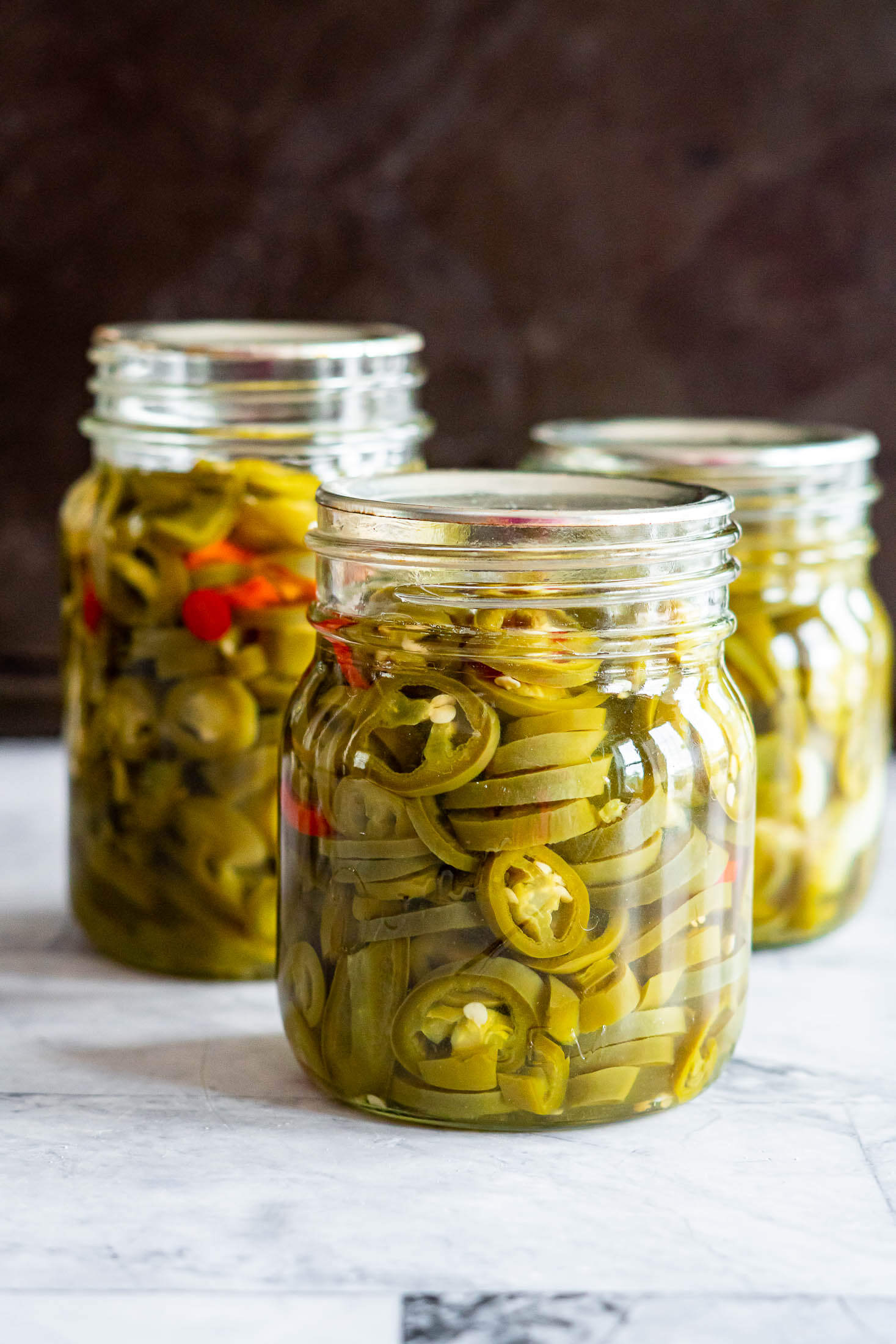
Pickled jalapeños are great for adding a tangy, acidic heat to your recipes. I love adding them to a number of things:
- sprinkled on air fryer nachos or tacos
- added to sourdough cornbread batter before baking
- as a zingy sourdough pizza topping
- stirred into smoked queso
- as a smoked brisket chili topping
- to top Traeger burgers or smoked hot dogs
- spread on cheese boards
- tucked into jalapeño and cheddar sourdough
More Great Canning Recipes


If you tried this Canned Pickled Jalapeños recipe or any other recipe on my blog, please leave a 🌟 star rating and let me know how it went in the comments below. Thanks for visiting!
📖 Printable Recipe
Pickled Jalapeños
Ingredients
- 2.5 – 3 lbs jalapeño peppers, fresh
- 6 cups white vinegar
- 2 cups filtered water
- ¼ cup pickling salt
- ¼ cup granulated sugar
- 4 cloves garlic, crushed
Instructions
Prepare Canning Jars:
- This recipe makes 3 pint jars and does not require sterilization due to the processing time. Prepare your jars, flats, and rings by washing in hot soapy water and rinsing well before setting aside on a clean kitchen towel until you're ready to use them.
- Fill a water bath canner, and set to boil over medium high heat.
Make The Brine:
- Add 6 cups of vinegar, 2 cups of water, 1/4 cup pickling salt, and 1/4 cup granulated sugar to a large saucepan. Bring the brine to a boil.
- Meanwhile, wash 2 1/2 – 3 lbs jalapeño peppers well, and slice into even sized rings.
Fill And Process The Jars:
- Once the pickling liquid comes to a boil, remove from heat and add the jalapeño slices and crushed garlic cloves. Soak the jalapeños for 30-60 seconds - they will change to a deeper, duller green, this is normal.
- Place a canning funnel on top of the jars and ladle the jalapeño rings and hot brine into the jars. Top off each clean jar with brine, leaving 1/2 inch headspace. If desired, run a canning spatula or clean chopstick along the edges of the jar to release the air bubbles.
- Wipe the lip of each jar before placing the lid and tightening the rings finger-tight. Transfer filled jars to the prepared boiling water canner using a jar lifter, ensure the jars are covered by 1-2 inches of water, cover the canner and return to a full boil.
- Once the water bath returns to a boil, begin to process for 10 minutes (at 0- 1,000 feet above sea level, see notes section for altitude adjustments).
- When processing is complete, turn off the heat, remove the lid from the water bath canner, and rest for 5 minutes before removing the hot jars and transferring them to a heat-proof surface to cool untouched for 24 hours, before wiping down, labeling with the contents and year and transferring to your storage pantry.
Notes
Altitude Adjustments:
Elevation / Processing Time0-1,000 feet / 10 minutes
1,001 – 3,000 feet / 15 minutes
3,001 – 6,000 feet / 20 minutes
6,001 – 8,000/ 25 minutes ** Processing time for pint sized jars only
Expert Tips
- Glove up. Slicing 2-3 pounds of jalapeños bare handed is how you end up sleeping with your hand in a bowl of milk (ask me how I know). Wear rubber or latex gloves, and if you forget and your hands start burning, rinse your hands in cooking oil before washing with dish soap to help breakdown the capsaicin.
- Adjust your time. Don't forget to adjust your processing time based on your elevation. The table above has you covered. Higher up means longer in the water bath, every time.
- No seal? No deal. If a jar doesn't seal after the 24 hour rest, don't panic, just move the jar of pickled 'penos to the fridge and use them within a few weeks. They're still safe to eat, they just won't be shelf stable anymore.
- Patience, peppers. Fresh canned pickled jalapeños tend to taste sharp and aggressively vinegary when they're fresh out of the canner. If you give them 2-3 weeks on the shelf before you crack one open, the brine mellows, the heat settles, and I find that the flavor gets better as they mature!
- Don't skip the dip! Soak the sliced peppers in the hot brine for 30-60 seconds before jarring - it's the difference between peppers that pack tight and peppers that float.
- Finger what? Finger-tight is such a vague term, here’s how I tighten my jars: screw the bands on until the jar starts to turn on the counter, then back off about a 1/8th of a turn.


Tangy right on recipe
But can I ask a question?
I want to make a lot of this recipe during the winter
I want to buy a bunch of fresh jalapeños and get them sliced up and then freeze
So I can can this winter
Can I use frozen sliced jalapeños for your recipe?? Gosh I hope so. Franny 🤔
I wouldn’t use frozen, I think they would lose too much shape and structure in the process. I would vote for buying and processing a bunch of batches right now, even though its a bunch more work up front.
My favorite chopped jalapeño recipe…the only one I use now. Instructions are well explained. I highly recommend this recipe. Thank you so much for posting this recipe!
Janet! You rock, thanks so much for using my recipe!
I have 250 ml jars not 500ml. Would the processing time still remain 10 min?
Hey Amber, you bet!
I think I did something wrong. For some reason my jalapeños are mushy. Is there anything you can think of that would do that. They were still tasty but texturally they are odd.
Hey Tabatha, next time you can try to use pickle crisp or reduce the amount of time you have them in the hot brine before bottling and preserving!
I am doing my jalapenos tomorrow and am hoping I can do them right. Going shopping now and am going to search for the Pickle Crisp as I do like them to stay crispy. I also am a cougher once I start cutting up jalapenos. Would love to know a trick to stop that from happening. The biggest question I have been searching for is how to pickle and water bathe diced jalapenos. One place I go says that they are probably too dense in the jar to pickle and can. But I buy them that way so I can’t understand why I couldn’t do them that way. Any insight? Thank you!
Hey Judi, I hear you on the coughing, mine starts as soon as I start rinsing my kitchen tools – the way I’ve figured to stop doing that is to use cold water, and to hit the switch and run out of the kitchen whenever I’m garburating anything to do with spicy peppers. HA!
As for the diced jalapenos, I’m not qualified to tell you if it’s safe and sometimes commercial canneries and industrial food producers have access to higher tech tools and techniques than we do in our home kitchens. I know that commercially produced sun dried tomatoes in oil are shelf stable, but not homemade versions. From a foodie perspective, I think that diced jalapenos would retain less texture after the pickling process than the sliced version. I’d suggest sticking to the slices and then dicing before using. Hopefully that helps.
Do I have to wait the 2 to 3 weeks before I could enjoy them?
You don’t have to wait, but the flavor definitely changes after the rest period. I find when tried right away they are sharp and vinegary and after a couple weeks that sharpness settles down and gives you a better flavor!
So unless I overlooked it what are the brine ingredient measurements?
Hey John, the exact measurements are at the bottom of the post in the recipe card. If you scroll to the top of the page and tap the “jump to recipe” button it will take you straight there!
@Ally, thank you for this information. The best jalapeno canning recipe I have ever tried.
So happy to hear this!
Hello… My novice question is… It states we process each jar for ten mins… Does this mean 30 mins for three pints… Or just 10 mins total for however many pints in the canner…forgive my ignorance I just wanna do this right… It’s been years since I have canned .. and I’m excited to do as much as I’m able to.. and is it safe to add more garlic? Thank you
Hey Tammy, the time remains the same regardless of number of jars 🙂 So if you have 1 or 3 jars the time remains 10 minutes.
My first jalapeño canning .These instructions are well written,comprehensive and the results are delicious.
Could I add crisping salt as well?
If you’re talking about the Pickle Crisp additive, that shouldn’t be a problem!
Excellent recipe…. So I am one of the “dingbats” that raw packed the peppers because that’s how I always did green beans. And yes, they are floating with an inch of space at the bottom.
Great instructions, one question- my canning experience before now was with pressure canning. I used my pressure canner without the top gauge, open steam escape.
I wasn’t sure if water bath canning was supposed to be with the lid as I did, or without the lid?
You aren’t a dingbat – just learning! It won’t massively impact the finished result, they’ll just float for a while then probably sink.
Yes, water bath should be done with the lid on, I have edited the post to make this more clear for future readers!
The clearest written instructions I’ve ever found for pickling and canning. I appreciate the elevation times as well. Thank you!!!
Thank you so much! This is such a great compliment – it’s a challenge to write concise directions that include enough information. I’m so happy they resonated with you. Hope you enjoy the recipe!
Novice here…so, how long do you soak the peppers in the brine with the garlic before ladling them into jars? Do I ladle the garlic into the jars, as well?
E, basically, you just want to soak the peppers in the brine for a 30-60 seconds. The reason for that is to help burst the cells and prevent them from floating up in the jars! I’m going to edit the post to reflect that!
I always add the garlic, not only does it impart a lot of flavor after the brine stage, it’s one of my favorite things in the bottom of a jar of pickles or peppers LOL
@E, no more than a minute. Yes, add bits of garlic into the jars.
I used the dish washer to sterilize and clean my jars and lids…while the white vinegar smell is admittedly strong, I didn’t wheeze…
A few things: First, maybe you could specify WHY it is important to dump the sliced peppers into the boiling brine before putting them into jars: so dingbats like me don’t think they’ll just skip that step and fill jars with raw jalapenos and pour the brine on top, then water bath them. End result is that you get a lot of empty space at the bottom of the jar, because the peppers soften up as they cook and take up less room in the jar. Secondly, a warning that a brine with this much white vinegar left me gasping for fresh air as I cooked and ladled. In 25 years of making pickles, I’ve never had apple cider vinegar do that to me. Would these taste as good with apple cider vinegar? And last, I doubled the recipe and had enough brine for six QUARTS of peppers, with a quart of brine leftover. It will take weeks to find out how successful I’ve been, but these are my thoughts the day after making them. 🙂
No dingbats here, Maureen, just people learning <3
I will definitely add it to the post, but the reason the peppers floated up in your jars was that you essentially raw packed them, vs hot pack. By adding the peppers to the hot brine for a few seconds, we're allowing the cell walls to burst and release some of the trapped air within the pepper itself - this helps to keep them suspended in the brine and avoids floating. Though after a bit they'll likely sink down. That might have also explained the extra brine, as the air comes out of the peppers, the brine is able to permeate those spaces.
I have never found vinegar to make me wheeze too much during pickle making, but I definitely feel like I have the black lung when I deal with HOT capcasin. OH my gosh, even rinsing a cutting board used for hot peppers in hot water sends me into a coughing fit. I haven't tried these with apple cider vinegar, the science behind it should work, but the ACV does have a different flavor that may or may not be desireable to you for your pickled jalapenos - that said, I'd be tempted to try a half batch, just to see!