
Hot Honey
This easy hot honey recipe takes just 10 minutes and uses only two ingredients, with an optional splash of vinegar to brighten the flavor. Whether you like mild or fiery heat, this recipe is fully adjustable to your taste.
Like it hot? Try these: dill pickle hot sauce, mango habanero hot sauce & sriracha salt
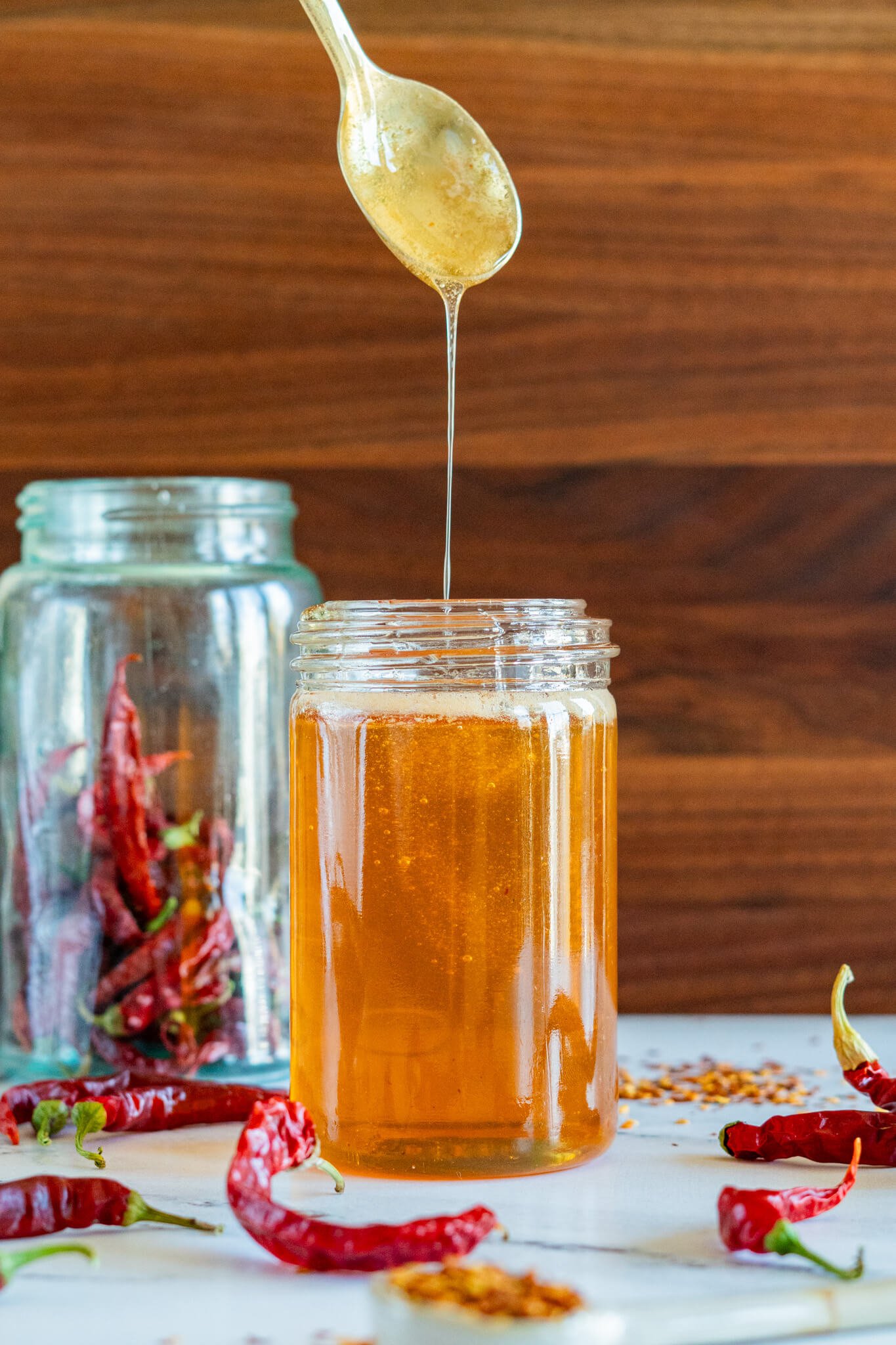
Craving The Recipe Details?

What it is: A quick and easy homemade hot honey made with raw honey and dried chili peppers or red pepper flakes, perfect for adding a sweet and spicy kick to any dish.
Why you’ll love it: In just 10 minutes, you get a versatile condiment that balances natural sweetness with a hot kick.
How to make it: Combine 1 cup honey with 4-5 chopped dried peppers or 1-2 tablespoons red pepper flakes in a small saucepan, heat gently until simmering, let the flavors infuse for 5 minutes, then strain and store in a sanitized jar.
We're in our fourth year of beekeeping, and if you've never heard of "bee math," it goes like this: you start with a couple of hives… and suddenly you're swimming in honey. What began as 50 pounds in our first season quickly turned into 150, then over 250 pounds by the third year.
Working with that much honey changes how you cook with it. You learn quickly how heat affects flavor, why moisture matters for shelf life, and how different honeys behave in recipes.
This homemade hot honey recipe is dedicated to bee math.
Jump to:
What Is Hot Honey?
Hot honey, sometimes called spicy honey, is a simple infused honey recipe made by gently heating honey with dried chili peppers or chili flakes to create a sweet and spicy condiment. The heat doesn’t hit all at once, the sweetness lands first followed by the spice, which is exactly what makes it so addictive.
It’s not a sauce and it’s not a glaze, though it works brilliantly as both. Use it as a hot honey glaze on roasted proteins or a hot honey sauce drizzled across fresh pizza.
Hot honey has been around Southern kitchens for generations, but it became a mainstream obsession when Mike’s Hot Honey had a viral moment in 2022.
The good news: homemade hot honey is better than any bottle you can buy, costs a fraction of the price, requires only simple ingredients, and takes about ten minutes start to finish.
Key Ingredients
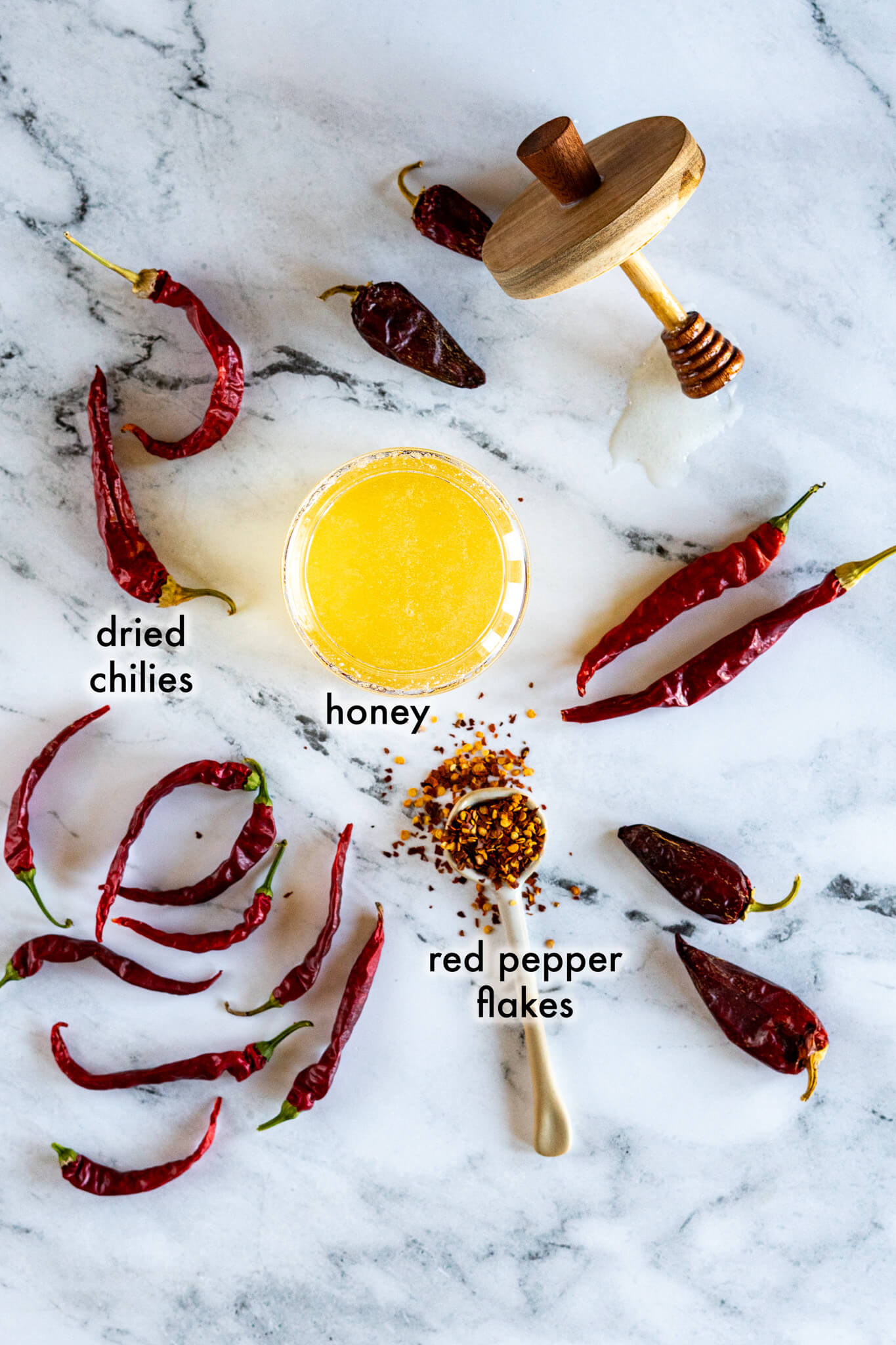
Honey: I’m using hyper-local raw honey, as in straight from my backyard, but I do recommend raw honey for hot honey whenever possible, because it has a more complex flavor profile and it is believed that local honey actually has health benefits!
Dried Peppers: For this batch of hot honey, I’m using dehydrated Red Flame peppers from my garden, but you can use pretty much any dried peppers or even crushed red pepper flakes! Red Flame peppers are a cayenne variety, with a Scoville rating between 30 and 50,000 SHU. This puts them on par with other cayenne peppers, Chili De Arbol, and some Thai peppers. If you like more kick, try habanero peppers. For less heat, opt for dried jalapenos or poblano peppers.
How To Make Hot Honey
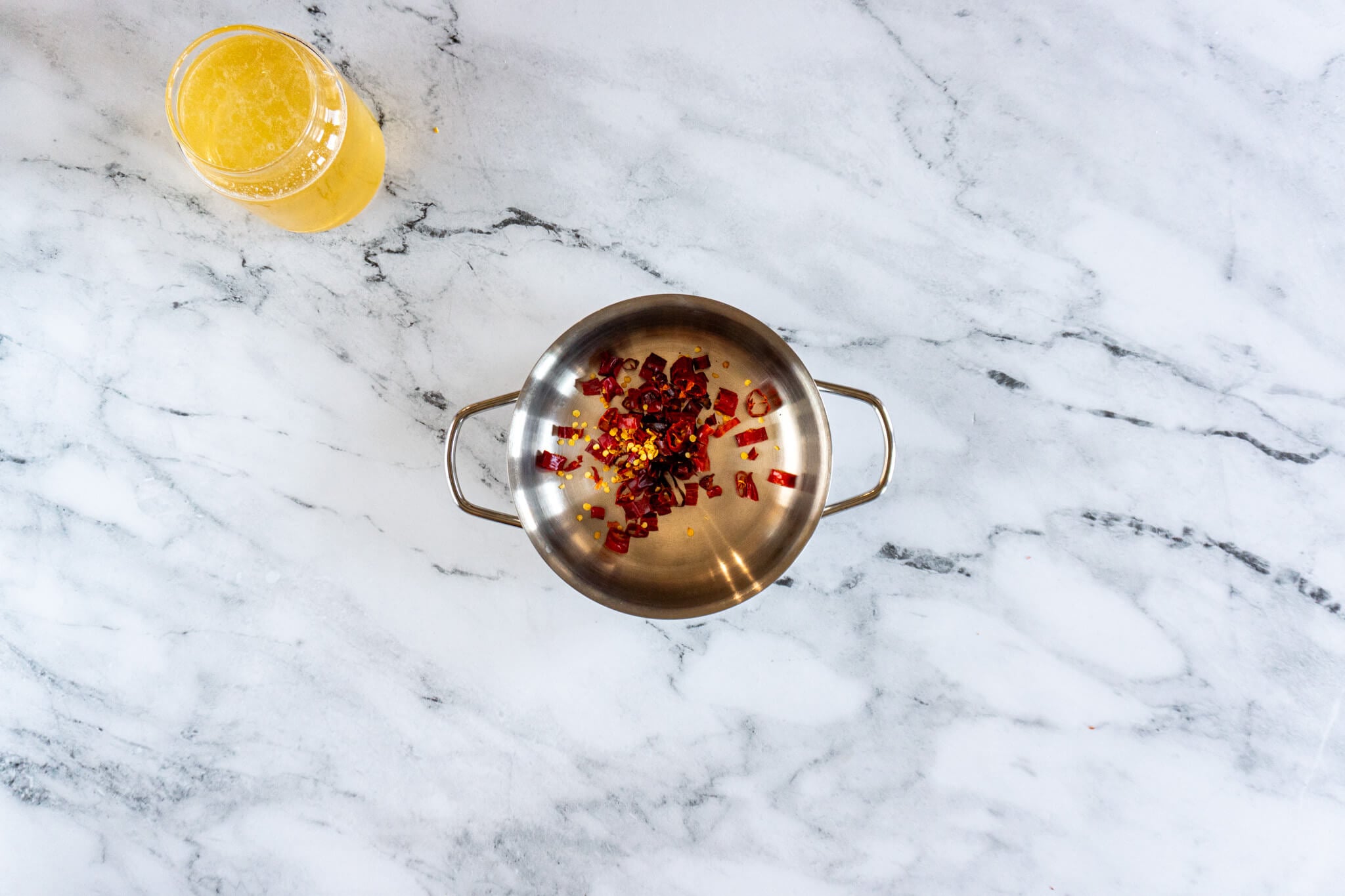
- Step 1: Add 2 cups of honey and 8-10 coarsely chopped dried peppers with their seeds or 3-4 tablespoons of dried chili flakes to a small heavy bottomed saucepan.
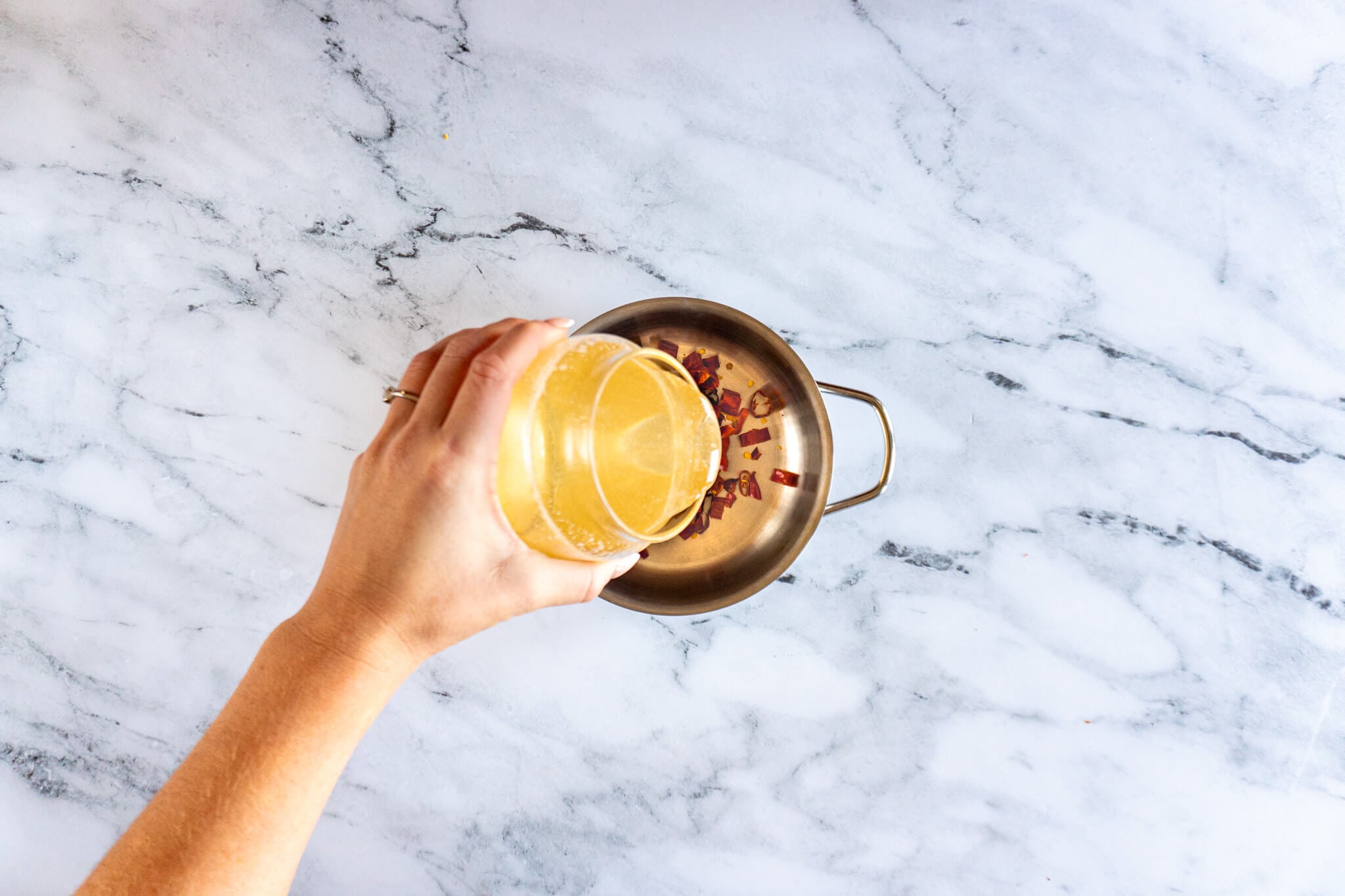
- Step 2: Heat the mixture on low until barely simmering. It’s important to NOT boil the honey – boiling honey expands rapidly and can make a mess, and at a certain point, boiled honey begins to make candy – which is not what we want all!
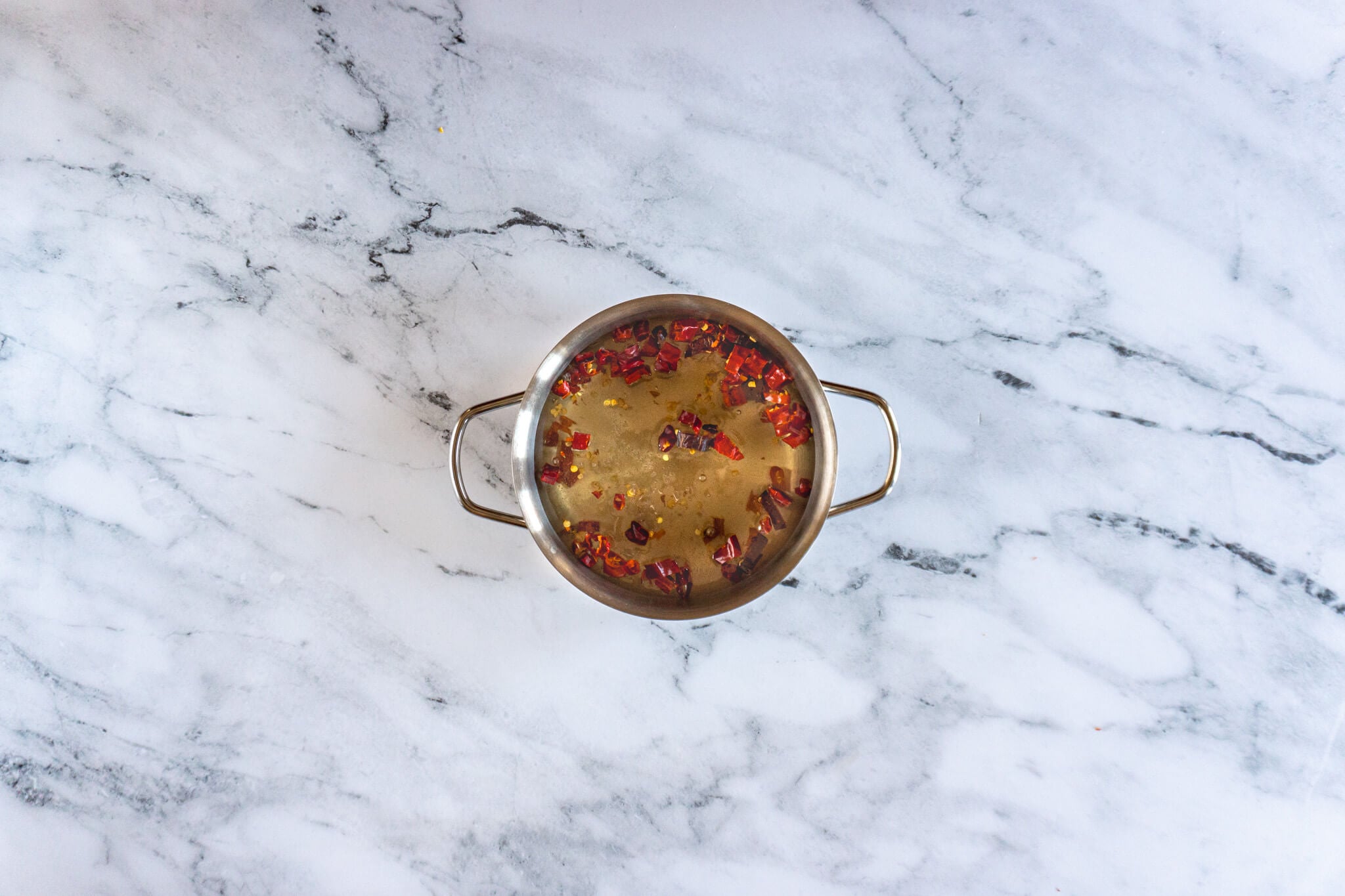
- Step 3: Simmer for 5 minutes, stirring regularly, then sample the honey:
Spicy enough: move to the next step
Not spicy enough: add a bit more peppers or pepper flakes and simmer for another 5 minutes before testing again
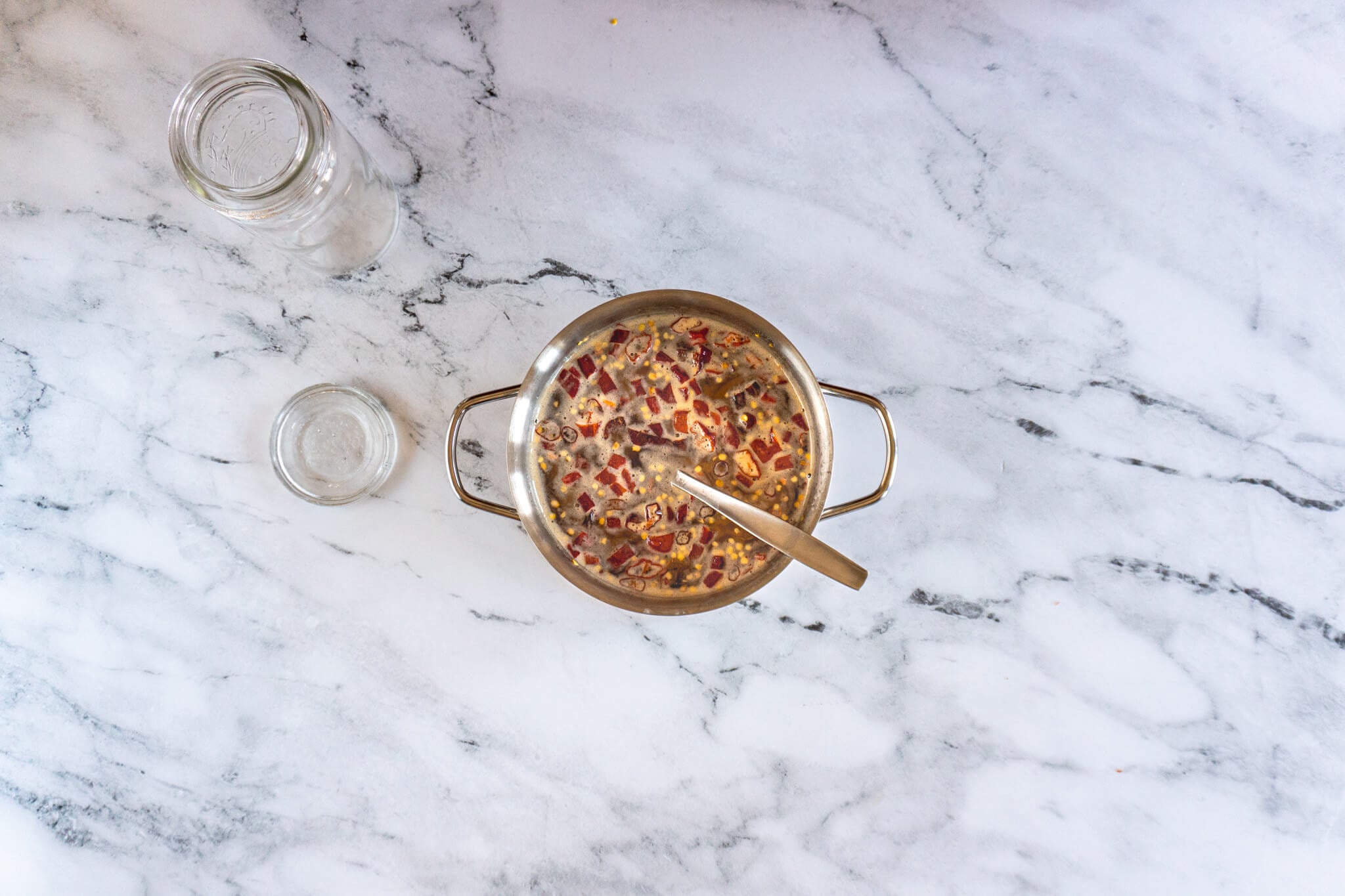
- Step 4: Remove honey from heat and allow to cool slightly. Meanwhile, sanitize a storage jar by washing in hot soapy water, rinsing well and drying completely.
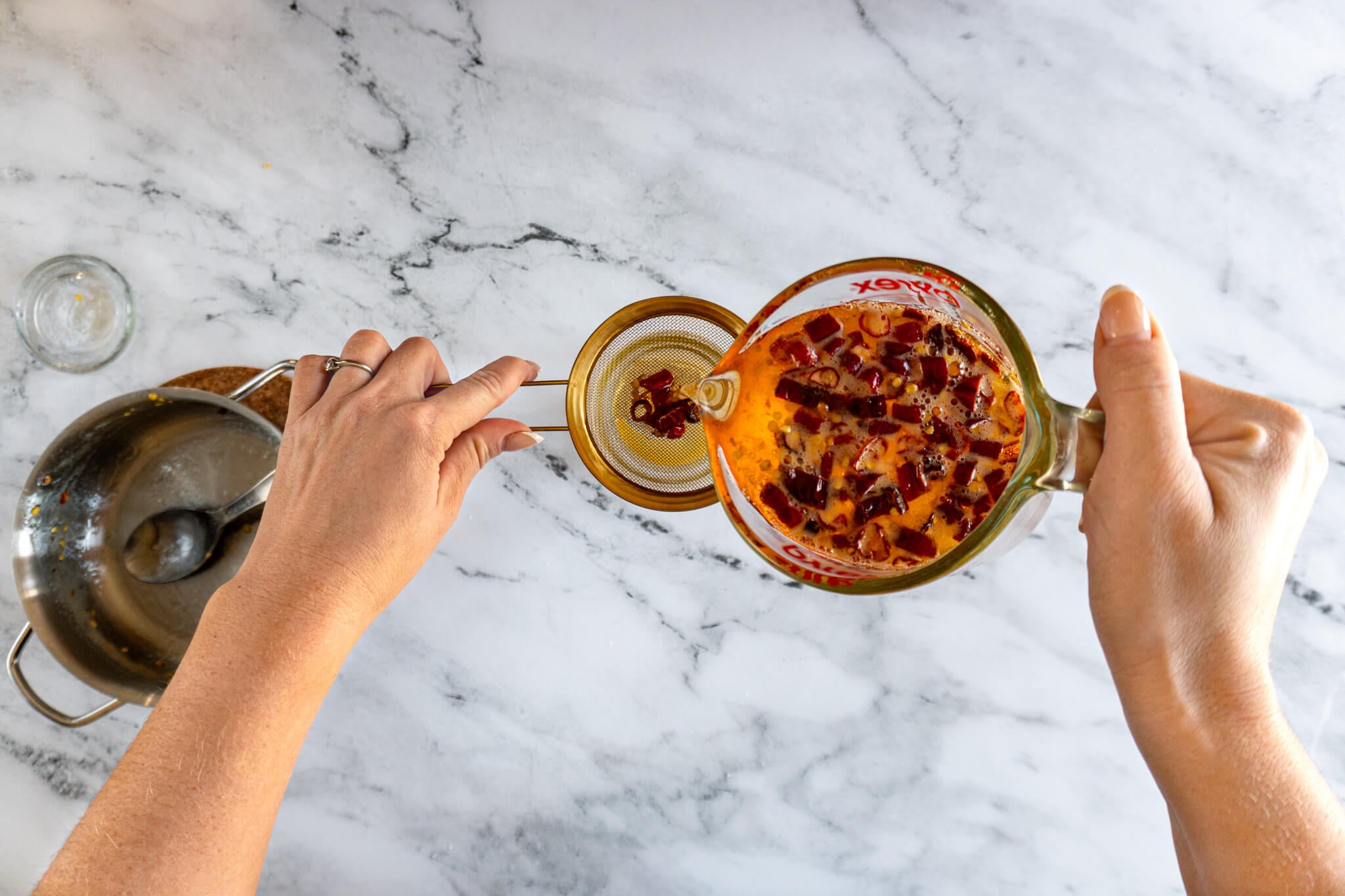
- Step 5: Using a fine mesh strainer, carefully strain the solids out of the warm honey. Honey flows more easily when warm, so don’t allow it to cool too much before straining.
If desired, you can leave the dried peppers or pepper flakes in the honey without straining. It does make a beautiful gift with the peppers intact, but the heat will likely continue to intensify in the honey during the storage period.
Expert Tips
- If you’ve got a jar of honey in the pantry that has crystallized, this is the perfect recipe to use it in! The heat during the infusion stage melts the sugar crystals and returns the honey to its liquid form.
- Fresh chili peppers can be used to infuse your honey, but I hate to add water to the mix, so I do not use that method. Honey has a long shelf life because the bees dry it to around 17% moisture content. Higher than 18% can actually cause fermentation of your hot honey.
- I do have a guide on drying peppers, and it works for any hot pepper.
Choosing Your Honey
Since honey is the backbone of this recipe, the type you choose will shape the final flavor more than anything else. Here’s what I’d reach for, and why, from someone who now has more honey than she knows what to do with!
Clover Honey Clover is the most common honey variety in North America and a reliable choice for hot honey. It has a light color, a clean and delicate sweetness, and a mild floral note that doesn’t compete with the pepper heat. Because it doesn’t have a strong personality of its own, the chili flavor gets to be the star. Clover has a moderate-to-high glucose content, which means it does crystallize within a few months, but that’s easy to fix (more on that below).
Canola Honey If you live in the Canadian prairies or northern US, your local honey is likely canola-dominant. Canola honey is nearly clear, very mild, and almost neutral in flavor. It’s sweet without being floral. The catch is that canola honey has one of the highest glucose-to-fructose ratios of any common variety, which means it crystallizes quickly, sometimes even in the hive before extracting. It will almost certainly solidify in your jar before you finish the bottle. This is not a problem; it’s actually a great reason to use it in this recipe. The gentle heat during the infusion step liquefies the crystals completely, and the finished hot honey stores well at room temperature.
Wildflower Honey Wildflower honey is produced by bees foraging from multiple flower species, which means the flavor varies by season, by region, and honestly by hive. It tends to be darker in color with a deeper, more complex flavor, sometimes fruity, sometimes earthy, sometimes almost caramel-like. It pairs beautifully with spicy peppers because the depth of flavor can hold its own. The crystallization timeline on wildflower honey is unpredictable because it depends on which flowers your bees visited, but it generally stays liquid longer than clover or canola.
Raw vs. Pasteurized Raw honey is minimally processed, it goes straight from the hive into the jar with only coarse filtering to remove wax and debris. It retains its natural enzymes, pollen, antioxidants, and full flavor profile. It also has a more distinct, complex taste that varies noticeably by floral source. The potential downside is that raw honey crystallizes faster, because all those natural particles (pollen, micro-crystals, bits of wax) give glucose molecules something to anchor to and organize around.
Pasteurized honey is heated and then rapidly cooled during processing. This kills wild yeasts, dissolves any existing crystals, and results in a product that stays liquid on store shelves much longer. The tradeoff is a milder, more uniform flavor and the loss of heat-sensitive enzymes and some antioxidants.
Here’s the beekeeper’s take: if you’re going to heat your honey during the infusion process anyway, some of raw honey’s heat-sensitive benefits are reduced regardless. That said, raw honey still has a more interesting flavor before you heat it, and the flavor depth carries into the finished product. I use my own raw wildflower honey and wouldn’t change it. But if all you have is a pasteurized clover honey from the grocery store, your hot honey will still be delicious.
The best honey is local honey. Wherever you are, buying from a local beekeeper means fresher honey, more variety, and the satisfaction of supporting your local economy.
Choosing Your Peppers
Every pepper variety has its own flavor profile and heat level. Here are some commonly available peppers:
| Pepper Variety | Flavor Profile | Scoville Heat Units |
|---|---|---|
| Jalapeno | Bright, crisp, grassy | 2,500 – 8,000 |
| Cayenne | Clean, sharp, neutral | 30,000 – 50,000 |
| Habanero | Sweet, floral, fruity | 100,000 – 350,000 |
| Scotch Bonnet | Sweet, fruity, tropical | 100,000 – 350,000 |
Should I Add Apple Cider Vinegar?
I prefer to make honey honey without vinegar, but you certainly can, and many do!
Apple cider vinegar is acidic, and that acidity does a few important jobs for your tastebuds. It cuts through the sweetness, which is substantial because honey is very sweet and concentrated. It provides a brightness that lifts the overall flavor without you being able to identify “I taste vinegar”, it just makes everything taste more vibrant. And the mild sourness from the vinegar actually counteracts and balances the heat from the peppers, making the spice feel cleaner and more pleasant rather than just hot.
How much to use: Start with 1 teaspoon of apple cider vinegar per cup of honey. Add it off the heat, after straining, and stir it in while the honey is still warm. Taste, and add a touch more if needed.
Hot Honey FAQs
The homemade hot honey shelf life when made with dried peppers or chili flakes is nearly indefinite. Make sure to store in a clean, sealed glass jar in a cool, dark spot like a pantry. Because dried ingredients introduce no moisture only flavor, the honey remains shelf-stable at room temperature, the same way plain honey stores. If you’ve made a particularly large batch, just make sure your jar is properly sanitized before filling it.
If you’ve used fresh peppers instead of dried, the shelf life is significantly shorter. Fresh peppers introduce moisture into the honey, which can push the water content high enough to create conditions for fermentation or spoilage. Strain out the peppers completely if you’ve gone the fresh route, and plan to use it within a month or so.
You can, with one important caveat. As a beekeeper, I think about moisture in honey a lot. Honeybees work incredibly hard to reduce the water content of nectar, fanning it with their wings over days until it reaches around 17% moisture before capping the cells with beeswax. That low moisture level is precisely what makes honey shelf-stable and resistant to spoilage. Once the water content climbs above roughly 18-20%, conditions become favorable for wild yeasts and fermentation.
Fresh peppers contain significant moisture. When you heat them with honey, some of that water is released into the mixture. Depending on the starting moisture level of your honey (raw honey can vary), adding fresh peppers may push things closer to that fermentation threshold. It may be fine. It may not. I don’t use fresh peppers because I don’t want to find out the hard way.
If you want to use fresh peppers, strain them out thoroughly, and use it within one month. If you want a brighter, fresher pepper flavor without the moisture risk, consider drying your own peppers first, I have a guide on how to do it.
The two easiest paths:
Stir in additional plain honey to dilute the heat. Add it gradually, tasting as you go. A quarter cup of plain honey stirred into a cup of too-spicy hot honey can bring things back to a manageable level.
Alternatively, a small splash of apple cider vinegar can help. Vinegar’s acidity doesn’t neutralize capsaicin directly, but it balances the overall flavor profile in a way that makes the heat feel less aggressive and more integrated. Try a teaspoon, stir well, and taste before adding more.
Going forward: it’s always easier to add more heat than to take it away. Start with fewer peppers, simmer for five minutes, taste, and build up gradually.
First and most importantly: crystallized honey is not bad honey. It hasn’t spoiled. It hasn’t gone off. It’s actually a sign that your honey is the real thing, minimally processed, full of the natural pollens and particles that high-quality honey contains.
Honey is a supersaturated sugar solution and the glucose in the honey has a tendency to precipitate out of solution over time and organize into crystals. The ratio of glucose to fructose in your honey, which is determined by whatever flowers the bees were visiting, dictates how quickly this happens.
Honeys high in glucose, like canola and clover, crystallize fastest. Canola honey can go from liquid to solid within weeks of extraction, and sometimes even before extraction. Wildflower honey crystallizes at unpredictable rates depending on the season. Cold temperatures speed crystallization up. If you’ve been storing your hot honey somewhere too cool, that’s likely accelerating the process.
To fix it: Set the sealed jar in a pot of warm water (not boiling, aim for around 95-110°F / 35-43°C) and let it sit, stirring occasionally, until the crystals dissolve and the honey returns to liquid. Don’t microwave it aggressively or heat it on direct high heat, which can alter the flavor and drive off aromatic compounds.
If you find your honey crystallizes frequently, that’s a feature of buying raw local, good quality honey rather than heavily filtered grocery store honey, and I’d argue it’s a worthwhile trade.
You can easily scale this recipe up or down, but stick to the 1 cup of honey to 4-5 dried peppers or 1 cup of honey to 2 tablespoons of red pepper flakes ratio.
2 cups of honey will produce a scant 2 cups of hot honey – you may lose a bit of volume to evaporation and residuals left in the sauce pan, but you’ll get pretty close to what you put into it.
Serving Suggestions
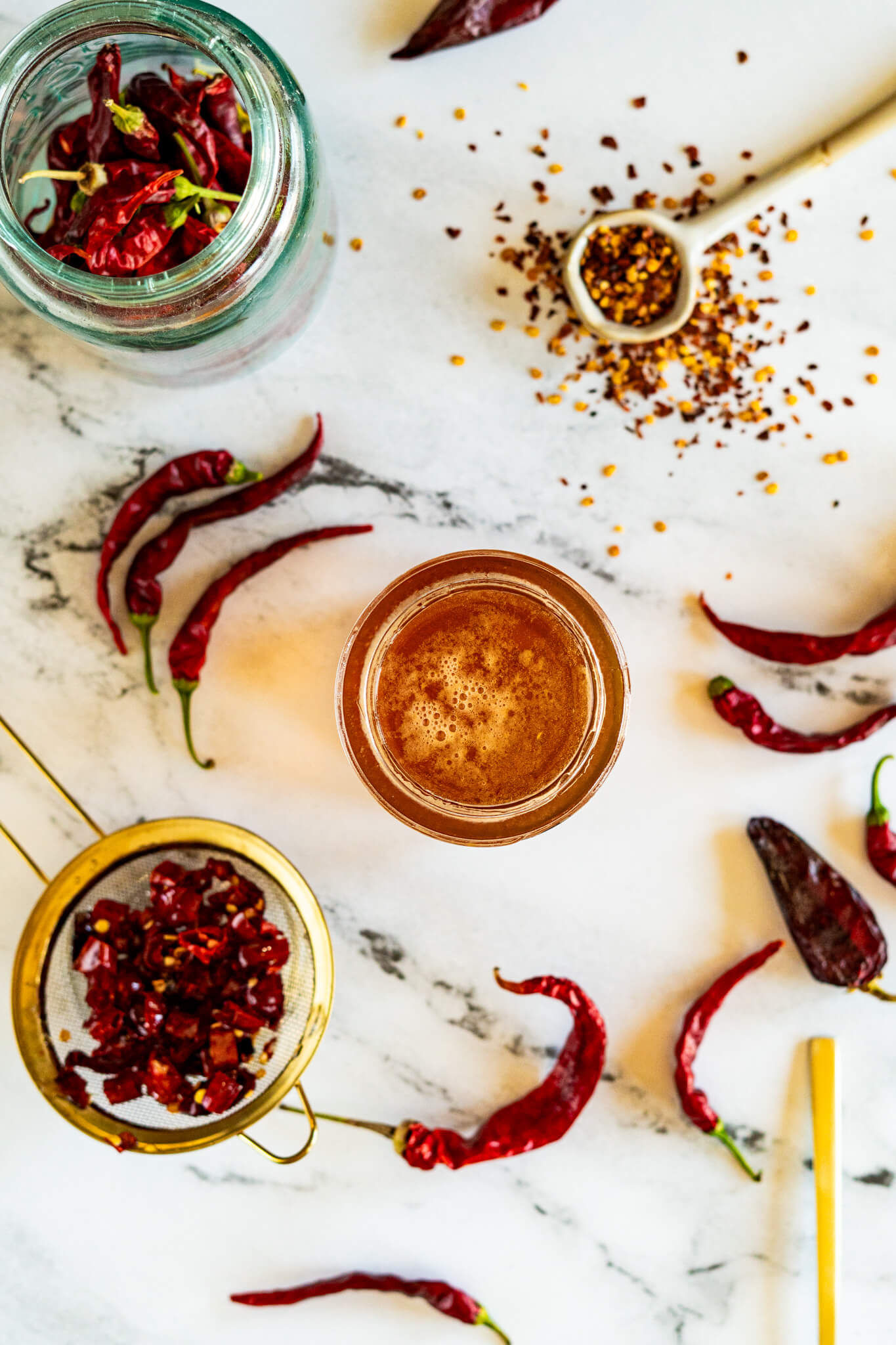
You’re going to love the sweet heat from this condiment so much, you’re going to wantx it on everything. Here’s are some hot honey drizzle ideas that you may not have had:
- on homemade sourdough pizza
- stir into cocktails (spicy margs, anyone?)
- on sous vide vanilla ice cream
- on homemade no-milk biscuits or sourdough cornbread
- on fried chicken or sous vide chicken wings
- on smoked brussels sprouts
- add to your favorite marinade
More Elevated Ingredients


If you tried this homemade hot honey recipe or any other recipe on my blog, please leave a 🌟 star rating and let me know how it went in the comments below. Thanks for visiting!
📖 Printable Recipe

Homemade Hot Honey Recipe
Ingredients
- 2 cups raw honey
- 8-10 dried peppers (coarsely chopped, with seeds) , OR 3-4 tablespoons red pepper flakes
Instructions
- Add 2 cups of honey and 8-10 chopped dried peppers and their seeds or 3-4 tablespoons of red pepper flakes to a small saucepan.
- Heat the mixture on low until barely simmering. Do not allow the honey to boil.
- Simmer for 5 minutes, stirring regularly, then sample the honey:Spicy enough: move to the next stepNot spicy enough: you can add a bit more peppers or pepper flakes and simmer for another 5 minutes before testing again.Too spicy: add a bit more honey to tone down the spice before moving to the next step.
- Remove honey from heat and allow to cool slightly. Meanwhile, sanitize a storage jar by washing in hot soapy water, rinsing well and drying completely.
- Using a fine mesh strainer, carefully strain the solids out of the warm honey. Cool, then cover before storing.
Notes
Expert Tips
- If you've got a jar of honey in the pantry that has crystallized, this is the perfect recipe to use it in! The heat during the infusion stage melts the sugar crystals and returns the honey to its liquid form.
- Fresh chili peppers can be used to infuse your honey, but I hate to add water to the mix, so I do not use that method. Honey has a long shelf life because the bees dry it to around 17% moisture content. Higher than 18% can actually cause fermentation of your hot honey.
- I do have a guide on drying peppers, and it works for any hot pepper.


Love honey, just bought another Five pounds. And love hot, hot peppers. Our honey is from Vanderhoof British Columbia Mountains. Fireweed.
I will be sure to try your recipe. Will be good on ice cream
Wayne
Nakusp, B.C.
Hi Wayne, fireweed honey sounds amazing! Did you know fireweed pollen is actually grey? We have some fireweed around her and the first time I saw fireweed pollen I was worried my hives were molding!